Gladiator
Jump to navigation
Jump to search
A gladiator (Latin: gladiator, "swordsman", from gladius, "sword") was a slave or professional fighter in ancient Rome.
Mosaics[edit]
-
 Mosaic at the National Archaeological Museum in Madrid showing a retiarius named Kalendio (shown surrendering in the upper section) fighting a secutor named Astyanax. The Ø sign by Kalendio's name implies he was killed after surrendering.
 -
 A mosaic from Bignor Roman Villa.
 -
 The Gladiator Mosaic, on display at the Galleria Borghese, is one of the earliest known examples of contemporary art with gladiators as subjects.
 -
 The Zliten mosaic from Libya (Leptis Magna) c. 2nd century CE: A Thraex and murmillo, a hoplomachus and murmillo (who is signaling his defeat to the referee), and a matched pair.
 -
 Two venatores fighting a tiger. Mosaic in Great Palace of Constantinople.
 -


.jpg)
Pottery and Glass[edit]
-
 Blue glass cup with gladiators fighting.
 -
 Helmet of a secutor depicted in a glass flask.
 -
 Oil lamp in the form of a gladiator.
 -
 2 Provocatores fighting on a oil lamp.
 -
 Murmillo defeats Thraex depicted on a flask.
 -
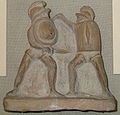 Terracotta showing the fight hoplomachus vs. Thraex.
 -
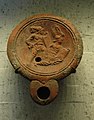 Murmillo fighting Thraex on an oil lamp.
 -
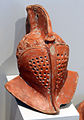 Secutor's helmet as a form of oil lamp.
 -
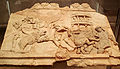 Terracotta plate with a scene of venatio.
 -
 Venator or hunter fighting a bear.
.jpg)

,_Split_Archaeological_Museum_(10420264655).jpg)


Weapons and Metalwork[edit]
-
 Secutor depicted on head of a knife.
 -
 Gladiator depicted on head of a knife.
 -
 Venator fighting a wild boar.
 -
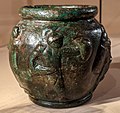 Bronze goblet with scenes of gladiators fighting.


Reliefs and Paintings[edit]
-

-
 Secutor fighting a retiarius on the ground, text reads IMPROBVM (Roman relief 2nd century AD).
 -
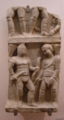 Secutor vs. retiarius, text reads VS SCOLASTICVS DAMASCENVS.
 -
 Secutor vs. retiarius.
 -
 Two female gladiators depicted on a relief from Halicarnassus.
 -
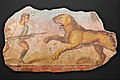 Venator fighting a lioness (mural painting).


Modern art works[edit]
-
 Jean-Léon Gérôme's Ave Caesar, morituri te salutant (1859).
 -
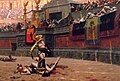 Pollice Verso by Jean-Léon Gérôme (1872).
 -
 Dying gladiator by Fedor Bronnikov (1856).
 -
 Spoliarium by Juan Luna (1884) with a despoiling scene (where dead gladiators are stripped of weapons and garments).
 -
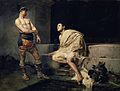 Gladiadores después del combate, painting by José Moreno Carbonero (1882).
 -
 Il gladiatore by Nicolao Landucci (c. 1850).
 -
 Roman gladiators by Howard Pyle (1911).
 -
 Gladiatorenkampf by Joseph Stallaert (by 1903).
 -
 Gladiadores victoriosos ofreciendo las armas a Hércules guardián by Andrés Parladé (1884).
 -
 Lion in the arena by William Rimmer (1873/1876).
_01.jpg)

.jpg)


.jpg)

.jpg)
