File:U5974-History.svg



Original file (SVG file, nominally 323 × 600 pixels, file size: 3 KB)
Captions
Captions
Summary[edit]


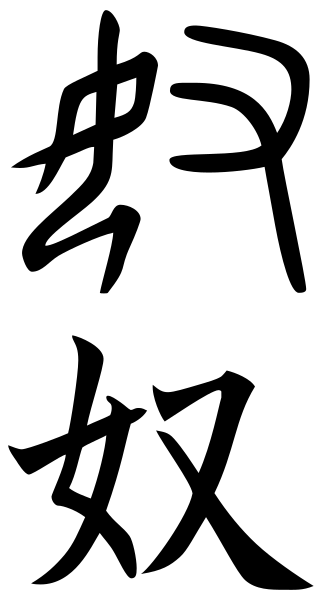
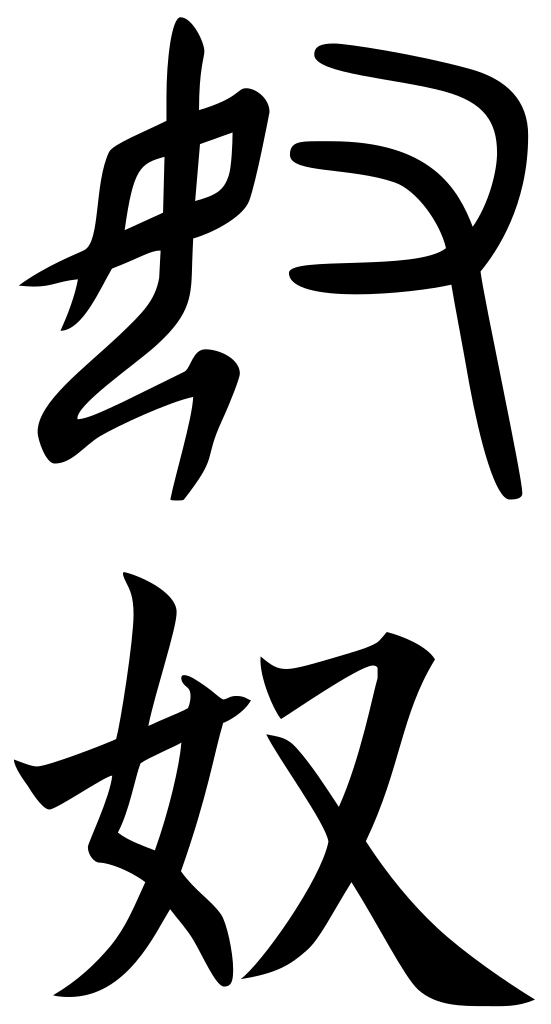
A look at the history of Chinese character Unicode U5974. The modern Mandarin Chinese pronunciation of this character is nu² or nú, while the ancient Chinese pronunciation was probably often more like no. This character is the historical origin of the nu Kana syllabary signs in Japanese (ぬ ヌ -- see en:Katakana#History and en:Hiragana#History).
Above: a schematized form of the earliest (quasi-pictographic) versions of this character, showing an apparent kneeling woman on the left, and a depiction of a right hand on the right. In the early forms of the character, the "hand" radical could also appear on the left; this variant became the character U36A2 (now obsolete, and not included in most modern Chinese fonts). For some references on early forms, see image description page Image:U5973-radical-38_early-form.svg .

Below: one particular quasi-calligraphic rendering of the modern version of this character U5974.
The character displays in your browser as follows: 奴
See also http://en.wiktionary.org/wiki/%E5%A5%B4
For Unicode info, see https://www.unicode.org/cgi-bin/GetUnihanData.pl?codepoint=5974 (official), https://www.fileformat.info/info/unicode/char/5974/index.htm
For the way to write the left half of the modern character, see Image:女-order.gif
This is an SVG version of image en:Image:U5974-History.png, using vector font versions of these graphics at [1].

For symbolism, see also Image:Dina-gor.svg , Image:Kajira-kef.svg and Image:Kajira-kef (alternate).svg .


.svg)
Licensing[edit]


|
I, the copyright holder of this work, release this work into the public domain. This applies worldwide. In some countries this may not be legally possible; if so: I grant anyone the right to use this work for any purpose, without any conditions, unless such conditions are required by law. |
File history
Click on a date/time to view the file as it appeared at that time.
| Date/Time | Thumbnail | Dimensions | User | Comment | |
|---|---|---|---|---|---|
| current | 01:53, 20 April 2013 | | 323 × 600 (3 KB) | AnonMoos (talk | contribs) | adding header now required |
| 09:21, 25 August 2008 |  | 323 × 600 (4 KB) | AnonMoos (talk | contribs) | minor fixes | |
| 13:25, 7 December 2006 |  | 323 × 600 (4 KB) | AnonMoos (talk | contribs) | slight simplification of vector data | |
| 21:02, 16 November 2006 |  | 323 × 600 (4 KB) | AnonMoos (talk | contribs) | adding white background to avoid potential display problems | |
| 06:38, 14 June 2006 |  | 323 × 600 (4 KB) | AnonMoos (talk | contribs) | A look at the history of Chinese character Unicode U5974. The modern Mandarin Chinese pronunciation of this character is ''nu²'' or ''nú'', while the ancient Chinese pronunciation was probably often more like ''no''. This character is the historical o |
You cannot overwrite this file.
File usage on Commons
The following 2 pages use this file:
File usage on other wikis
The following other wikis use this file:
- Usage on en.wikipedia.org
- Usage on fr.wikipedia.org
- Usage on it.wikipedia.org
