File:Vulva symbols.svg

Original file (SVG file, nominally 500 × 600 pixels, file size: 3 KB)
Captions
Captions
Summary[edit]
| Description |
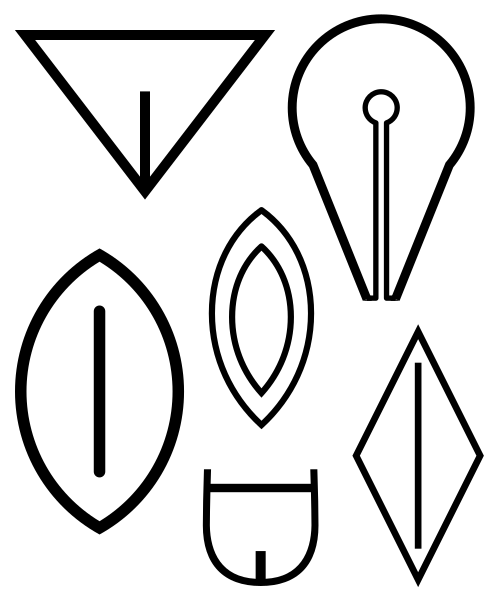
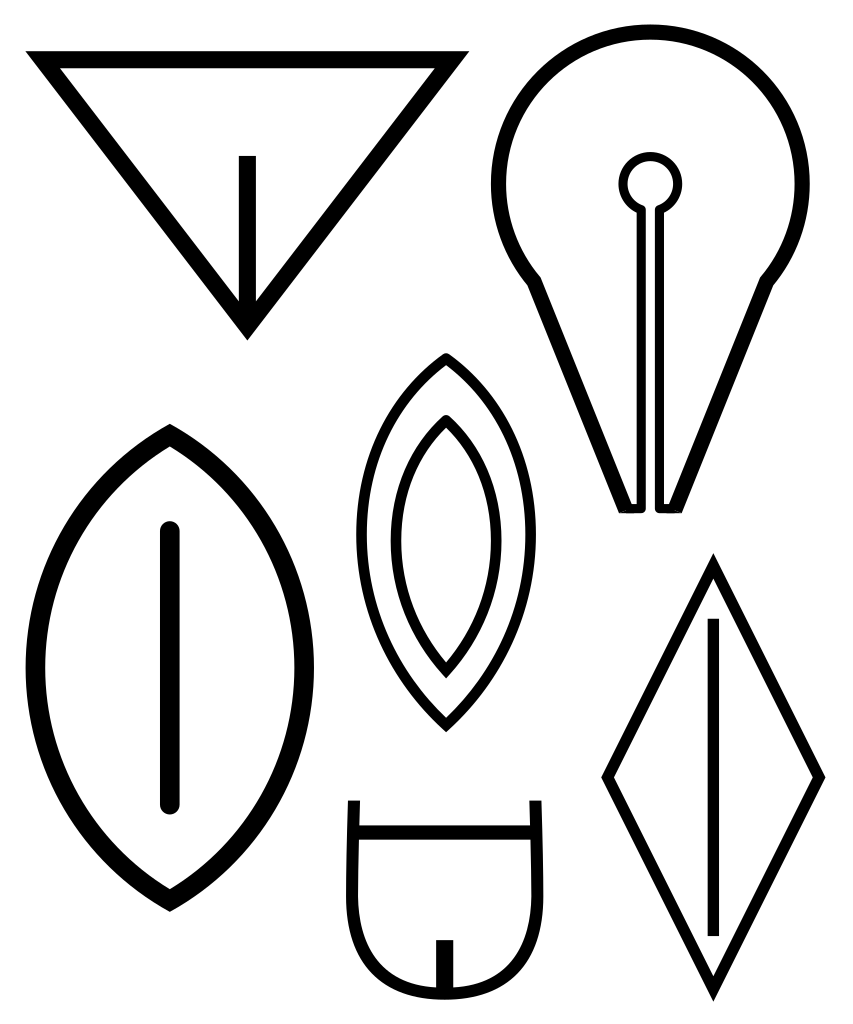
Six symbolic abstract representations of external female genitals (i.e. "yonic" symbols) which have been used in various historical/cultural contexts: 1) Upper left: A schematized drawing of the pubic triangle; among other things, this is the earliest archaic form of the ancient Sumerian cuneiform sign MUNUS (meaning "woman"); see Image:Ishtar vase Louvre AO17000-detail.jpg. The later form of this cuneiform sign is no longer pictographic, formed of four wedge shapes: 2) Upper right: A composite version of Hindu Yoni symbols. It combines features of various versions of Indian Yoni symbols (such as the one seen in Image:Lingam.jpg), but this particular shape may not itself be an authentic Hindu symbol. (For a somewhat similar symbol in a non-Hindu context, see Image:Vulve stylisée.JPG .) 3) Lower left: One form of the pointed oval encountered in many contexts as a representation or symbol of the vulva (including as part of medieval Sheela-na-gig figures). This particular version is based on a description in the book "Blood Brothers of Gor", using the geometry of the Vesica Piscis configuration (i.e. the overlap between two circles of equal diameter, where the center of each circle is on the circumference of the other). For one variation of this (a pointed oval within a circle), see Image:Dina-gor.svg or Image:Triple-Goddess-Waxing-Full-Waning-Symbol-multicolored.svg . 4) Center: Oval within oval (another variation of the preceding). 5) Lower center: Quasi-original form of an Egyptian hieroglyph used in the spellings of the ancient Egyptian words for "woman" and "vulva" (according to James P. Allen's Middle Egyptian: An Introduction to the Language and Culture of Hieroglyphs, where it is assigned the number D280a and described as an abstract representation of the pelvis and vulva). In ancient Egyptian inscriptions, this sign is generally merged with or replaced by hieroglyphs N41
|
||||
| Date | |||||
| Source |
Source: Own work (symbol shapes created by myself from scratch, except that the lower right is taken from Image:Symbol píča.svg ).  This vector image includes elements that have been taken or adapted from this file:  Symbol píča.svg. Symbol píča.svg. |
||||
| Author | AnonMoos | ||||
| Other versions |
For some further prehistoric depictions, see image 060214_cave_vulva_02.jpg linked from http://www.livescience.com/history/060214_cave_art.html ...
|






Licensing[edit]


|
I, the copyright holder of this work, release this work into the public domain. This applies worldwide. In some countries this may not be legally possible; if so: I grant anyone the right to use this work for any purpose, without any conditions, unless such conditions are required by law. |
File history
Click on a date/time to view the file as it appeared at that time.
| Date/Time | Thumbnail | Dimensions | User | Comment | |
|---|---|---|---|---|---|
| current | 03:20, 24 September 2022 | | 500 × 600 (3 KB) | Smasongarrison (talk | contribs) | slimmed down with svgomg // Editing SVG source code using c:User:Rillke/SVGedit.js |
| 05:51, 5 April 2017 |  | 500 × 600 (4 KB) | AnonMoos (talk | contribs) | Reverted to version as of 11:32, 2 September 2008 (UTC) | |
| 20:38, 15 January 2017 |  | 938 × 1,125 (108 KB) | JMCC1 (talk | contribs) | error in egyptian symbol | |
| 11:32, 2 September 2008 |  | 500 × 600 (4 KB) | AnonMoos (talk | contribs) | tweaking most-recently added symbol for exact symmetry | |
| 22:55, 30 September 2007 |  | 500 × 600 (4 KB) | AnonMoos (talk | contribs) | adding further symbol | |
| 07:13, 4 September 2007 |  | 500 × 600 (3 KB) | AnonMoos (talk | contribs) | adding symbol | |
| 20:48, 26 August 2007 |  | 500 × 600 (2 KB) | AnonMoos (talk | contribs) | Four symbolic representations of external female genitals as they have been used in various historical/cultural contexts: 1) Upper left: A schematized drawing of the pubic triangle; among other things, this is the earliest archaic form of the ancient Sum |
You cannot overwrite this file.
File usage on Commons
The following 4 pages use this file:


File usage on other wikis
The following other wikis use this file:
- Usage on als.wikipedia.org
- Usage on ca.wikipedia.org
- Usage on cs.wikipedia.org
- Usage on de.wikipedia.org
- Usage on en.wikipedia.org
- Usage on en.wikiquote.org
- Usage on es.wikipedia.org
- Usage on fr.wikipedia.org
- Usage on ja.wikipedia.org
- Usage on pl.wikipedia.org
- Usage on ru.wikipedia.org
- Usage on sv.wikipedia.org
- Usage on uk.wikipedia.org
- Usage on uz.wikipedia.org
- Usage on www.wikidata.org
- Usage on zh.wikipedia.org
