Liberal arts

The Seven liberal arts[edit]
The Seven liberal arts were the normal curricula from classical antiquity until the end of the Late Middle Ages, and somewhat later in some parts of Europe. The term modern term liberal arts refers to a particular type of educational curriculum broadly defined as a classical education. The term 'liberal arts' is described in the Encyclopædia Britannica as a "college or university curriculum aimed at imparting general knowledge and developing intellectual capacities, in contrast to a professional, vocational, or technical curriculum."
Сім гуманітарних мистецтв були звичайною навчальною програмою від класичної античності до кінця Пізнього Середньовіччя і дещо пізніше в деяких частинах Європи. Сучасний термін "гуманітарні науки" відноситься до певного типу освітніх програм, які в широкому сенсі визначаються як класична освіта. У Британській енциклопедії термін "гуманітарні науки" описується як "навчальна програма коледжу або університету, спрямована на передачу загальних знань і розвиток інтелектуальних здібностей, на відміну від професійної, професійно-технічної або технічної навчальної програми".
- History
In classical antiquity, the term designated the education proper to a freeman (Latin: libera, "free") as opposed to a slave. ■Martianus Capella (5th century AD) defined the seven Liberal Arts as grammar, dialectic, rhetoric and geometry, arithmetic, astronomy, music. ■Subsequently, later after the founding of the first western universities in the High Middle Ages the curricula of the medieval Western university the seven liberal arts were:
- the Trivium: grammar ■ rhetoric ■ logic
- the Quadrivium: geometry ■ arithmetic ■ music ■ astronomy
In that era, mastery of the seven was a necessary precursor to the study of Theology, at the time the purpose of founding most universities. In modern colleges and universities, the liberal arts include the study of theology, art, literature, languages, philosophy, history, mathematics, and science.
- Історія
У класичній античності цим терміном позначали освіту, притаманну вільній людині (лат. libera - "вільний"), на відміну від раба. Мартіан Капелла (V ст. н.е.) визначив сім гуманітарних мистецтв: граматика, діалектика, риторика і геометрія, арифметика, астрономія, музика. Згодом, після заснування перших західних університетів у Високому Середньовіччі, навчальні програми середньовічних західних університетів складали сім вільних мистецтв:
- тривіум
- граматика ■ риторика ■ логіка
- квадривіум
- геометрія ■ арифметика ■ музика ■ астрономія
У ту епоху оволодіння цими сімома науками було необхідною передумовою для вивчення богослов'я, що в той час було метою заснування більшості університетів. У сучасних коледжах та університетах гуманітарні науки включають вивчення богослов'я, мистецтва, літератури, мов, філософії, історії, математики та природничих наук.
- Expansion movement to include the visual arts
During the Renaissance a considerable propaganda campaign was mounted to support the promotion to the number of liberal arts of architecture, painting and sculpture, though not necessarily for their inclusion in the educational curriculum in the same way. Previously they had been classified among the mechanical or manual arts. Among those writing to support their inclusion were Leon Battista Alberti, Leonardo da Vinci, Giorgio Vasari and many others. At least in Italy, and among Renaissance humanists, the battle was largely won by about 1500, though in "remoter nations" like Spain and England the process took up to another century.
- Розширення руху на візуальне мистецтво
В епоху Відродження була розгорнута значна пропагандистська кампанія на підтримку зарахування архітектури, живопису та скульптури до числа гуманітарних мистецтв, хоча це не обов'язково означало їхнє включення в освітню програму в тому ж порядку. Раніше вони були класифіковані як механічні або ручні мистецтва. Серед тих, хто писав на підтримку їхнього включення, були Леон Баттіста Альберті, Леонардо да Вінчі, Джорджо Вазарі та багато інших. Принаймні в Італії та серед гуманістів епохи Відродження ця битва була в основному виграна приблизно до 1500 року, хоча у "віддалених країнах", таких як Іспанія та Англія, цей процес зайняв ще одне століття.
-
 Herrad von Landsberg: Hortus delicarium, 1180
 -
 Herrad von Landsberg
 -
 Herrad von Landsberg (fragment)
 -
 Sandro Botticelli. Lorenzo Tornabuoni before the Seven liberal arts
 -
 Triumph of St Thomas and Allegory of the Sciences, Santa Maria Novella, Florence


Trivium[edit]
Grammar[edit]
-
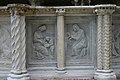 Grammar and Dialectic (Fontana Maggiore).
 -
 Priscianus. Allegory of grammar
 -
 Grammar (Cathedrale of Chartres)


Dialectic[edit]
-
Grammatic and dialectic (Fontana Maggiore).
Rhetoric[edit]
-
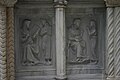 Rhetoric and Arithmetic (Fontana Maggiore).

Quadrivium[edit]
Music[edit]
-
 Geometry and music (Fontana Maggiore).

Arithmetic[edit]
-
Rhetoric and Arithmetic (Fontana Maggiore).
Geometry[edit]
-
 Euklid. Allegory of geometrie
 -
Geometry and music (Fontana Maggiore).

Astronomy[edit]
-
 Astrology (astronomy) and philosophy (Fontana Maggiore).

