Pederasty
Jump to navigation
Jump to search
Deutsch: Der Begriff Päderastie bezieht sich im klassischen und akademischen Sinn auf Liebesbeziehungen zwischen erwachsenen Männern und geschlechtsreifen Jugendlichen. Diese Beziehungen können sexuell geprägt sein oder auch nicht, freiwillig oder unfreiwillig, sentimental oder käuflich. Ihre Legalität ist von den jeweiligen Schutzaltersgrenzen und Gesetzen zur Homosexualität abhängig.
English: In the classic and academic sense, pederasty refers to the hebephilic or ephebophilic relationship between an adult male and an adolescent boy. Such relationships may be sexually expressed or not, consensual or nonconsensual, sentimental or commercial, and their legality will vary depending on local age of consent laws and prohibitions on homosexuality. The term can also be employed of the attraction of the man to the boy, whether or not reciprocated. It is analogous to korephilia.
Español: En español la palabra pederastia (del griego país o paidós: «niño» o «muchacho» y eran: «querer») se refiere a la práctica sexual abusiva y delictiva entre un varón adulto y un menor de edad.
El término «pederastia» se ha visto confundido con otros dos conceptos:
- Homosexualidad masculina: Por malinterpretación de los textos clásicos griegos, «pederasta» ha introducido el matiz semántico de la homosexualidad masculina.
- Paidofilia o pedofilia: A pesar de que etimológicamente significan lo mismo (ya que ambas se basan en paidós: «niño» o «adolescente»), la pedofilia no se refiere al abuso sexual, sino a la mera tendencia sexual o atracción entre un hombre adulto y un adolescente (en Grecia generalmente un erastes y su pupilo). Este uso es distinto del uso comun en los paises de habla inglesa, donde "pedofilia" se refiere a la atracción y contacto sexual entre un adulto y una persona de menos de trece años. Al primar en el mundo civilizado un Derecho penal de acto, y no un Derecho penal de autor, se castiga la pederastia pero no la pedofilia, es decir, el abuso sexual real y no la mera tendencia sexual.
Français : Le mot pédérastie renvoie à la relation amoureuse entre un homme adulte et un garçon adolescent, que celle-ci se traduise ou non par des rapports sexuels, qu'elle soit ou non de type consensuel, de nature sentimentale ou bien marchande. La légalité de telles relations dépend des lois en matière de protection des mineurs et des interdits concernant l'homosexualité, variables d'un État à l'autre. Le terme peut également servir à désigner l'attirance d'un homme pour un garçon, que cette dernière soit réciproque ou non.
Português: No senso clássico e acadêmico, pederastia refere-se a relação erótica entre um homem adulto e um garoto adolescente. Tal relação pode ser seualmente expressada ou não, consensual ou não consensual, sentimental ou comercial, e a sua legalidade irá variar dependendo do local, leis e proibições da homossexualidade. O termo também pode ser empregado para a atração física de um homem para um garoto, recíproca ou não.
Ancient Greece / Grèce antique / Griechische Antike[edit]
Mythical / Mythologie[edit]
-

-

-
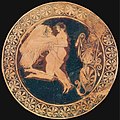 Hyacinthus and Zephyrus
 -
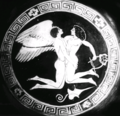 Hyacinthus and Zephyrus


Daily life / Vie quotidienne / Alltag[edit]
-
 Pederastic courtship. Paris, Musée du Louvre.
 -
 Courtship gift. Paris, Musée du Louvre.
 -
 Courtship scene
 -
 Pederastic erotic scene Louvre F85bis.
 -
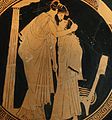 Man kissing a boy. Briseis Painter. Paris, Musée du Louvre.
 -
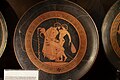 Pederasty scene. Musée de l'érotisme de Paris
 -
 Pederasty scene. Musée de l'érotisme de Paris
 -
 Pederasty scene
 -
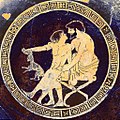 Pederasty scene


Military / Vie militaire / Militär[edit]
Symposium[edit]
-
 Symposium scene. Fresco from a tomb in Paestum (Italy).
 -
 Symposium scene. Fresco from a tomb in Paestum (Italy).


Ancient Rome / Rome antique / Roma antica / Antikes Rom[edit]
-
 Antinous (c. 110–130 CE). He was the beloved of the Roman Emperor Hadrian.
 -
 Ecouen Antinous.
 -
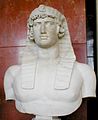 Antinous as Egyptian god Osyris.
 -
 Antinous (Delphi, Greece).
 -
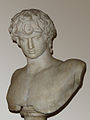 Antinous - Antinoo (Palazzo Altaemps, Rome).
 -
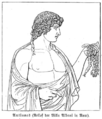 Antinous - Antinoo.
 -
 Emperor Hadrian, on a coin.
 -
 Emperor Hadrian, on a coin.
 -
 Emperor Hadrian, on a coin.
 -
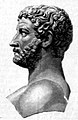 Emperor Hadrian. - L'imperatore Adriano, amante di Antinoo.
 -
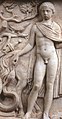 Polydeukion, here portrayed in a votive relief (2nd c. E.E.), was the favorite pupil and beloved of stoic philosopher and millionaire Herodes Atticus.
 -
 Ganymede - Ganimede (Museo delle Terme, Rome, Italy).
 -
 The rape of Ganymede (Museo archeologico, Venice, Italy) - Il ratto di Ganimede. Museo archeologico, Venezia.
 -
 Ganymede (Musée du Louvre, Paris, France).
 -
 Man and youth having sex, Warren Cup
 -
 Young man and boy having sex, Warren Cup
 -
 Hadrian and Antinous in Egypt.


_Hadrian_and_Antinous_in_Egypt.jpg)
Japan / Japon[edit]
-
 Three samurais
 -
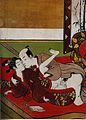 Suzuki Harunobu Shunga, ca. 1750.


China / Chine[edit]
-
 The Way of the Academicians from “Hua Ying Chin Chen” (Variegated Positions of the Flower Battle), China, Ming dynasty (1368–1644)
 -
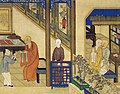 "Old Monk Received into a Wealthy Man's House while his Young Companion is being seduced by the Owner", Mid nineteenth century, Silk painting, F. M. Bertholet Collection


Muslim lands / Pays musulmans / Islamische Länder[edit]
Persia / Perse / Persien[edit]
-
 Mahmoud & Ayaz, and Shah Abbas; Unknown artist - Moraqqa; 17th century Reza Abbasi Museum
 -
 Ayaz kneeling before Sultan Mahmud of Ghazni. A miniature painting from a fifteenth century manuscript of six poems by 'Attar. "Six poems" by Farid al-Din 'Attar Southern Iran, 1472 British Library, London
 -
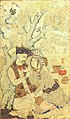 Shah Abbas I & wine boy
 -
 Men and youths by a stream - Ceramic panel from Chehel Sotoun
 -
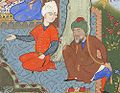 Youth seeking his father's advice
Miniature illustration to the Haft Awrang of Jami, in the story A Father Advises his Son About Love Freer and Sackler Galleries, Smithsonian Institution, Washington, DC. -
 Persian youth playing chess with two suitors Illustration to the Haft Awrang of Jami, in the story A Father Advises his Son About Love Freer and Sackler Galleries, Smithsonian Institution, Washington, DC.
 -
 Youth conversing with suitors
Miniature illustration from the Haft Awrang of Jami, in the story A Father Advises his Son About Love. Freer and Sackler Galleries, Smithsonian Institution, Washington, DC. -
 Sheikh and boy partying in a garden
 -
 Saki - Reza Abbasi - Moraqqa’-e Golshan 1609 Golestan Palace


Ottoman empire / Empire ottoman / Osmanisches Reich[edit]
-
 Kocek
Kocek -
 Tellak
 -
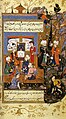 Jalal al-Din Rumi, Founder of the Order of the Whirling Cerviches, Showing His Love for His Young Disciple Hussam al-Din Chelebi


Pre-modern Europe / Europe prémoderne / Europa premoderna / Vormodernes Europa[edit]
Zeus and Ganymede / Zeus et Ganymède / Zeus e Ganimede[edit]
Images up to 1800 ca.
-
 Zeus and Ganymede + Apollo and Cyparissus (1522)
 -
 Antonio da Correggio (Antonio Allegri) (1489-1534), Ratto di Ganimede (1531), (Kunsthistorisches Museum, Vienna).
 -
 Illustrazione per gli Emblemata di Andrea Alciati (1534).
 -
 Raffaello da Montelupo (1505-1566), Giove bacia Ganimede - Jupiter kisses Ganymede (1550 ca.).
 -
 Nicolas Beatrizet (1515-1565), Zeus and Ganymede.
 -
 Illustrazione per gli Emblemata di Andrea Alciati: Ganymedes - In deo laetandum
 -
 Tempesta, Antonio (1555-1630) - In aquilam transformatus Iupiter Ganymedem rapit.
 -
 Cherubino Alberti (16th century), Zeus and Ganymede.
 -
 16th century.
 -
 François Chauveau, Enlevement de Ganymède (17th century)
 -
 Lelio Orsi (16th century), Ratto di Ganimede. (Museo estense, Modena, Italy).
 -
 Damiano Mazza, Ratto di Ganimede, 16th century (National Gallery, London).
 -
 Rembrandt Harmenszoon Van Rijn (1606-1669), The rape of Ganymede, (1635). (Gemäldegalerie, Dresda).
 -

-
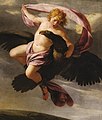 Eustache Le Sueur, "Abduction of Ganymede"
 -
 Carlo Cesio (1626-1686), Ganimede e Giove, da: A. Carracci, Illustrazione de la Galleria Farnese (1675).
 -
 Annibale Carracci (da), Ganimede e l'aquila - Incisione tratta dall'affresco tutt'ora a Palazzo Farnese (Roma)
 -
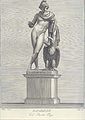 Dolcibene: incisione della statua del Ganimede dei Musei vaticani (1785 ca).
 -
 Grangerel, incisione da Rubens 1786/1808.
 -
 Zeus kissing Ganymede - A copy of an original by Wilhelm Böttner. Originally painted circa 1780. This copy was painted in the 19th century


.jpg)

_-_In_aquilam_transformatus_Iupiter_Ganymedem_rapit.jpg)

_-_f_bn_sc._Saslow_p._138.jpg)


,_Ganimede_e_Giove_da_A._Carracci,_Ill._de_la_Galleria_Farnese,_1675.jpg)


.jpg)
Portraits / Portraits / Ritratti[edit]
-
 Emperor Hadrian. Modern bust.
_Ancient_Roman_busts_in_the_Museo_archeologico_nazionale_-_Colossal_head_of_Hadrian.jpg)
Miscellaneous topics / Autre / Miscellanea / Verschiedenes[edit]
-
 Socratic love. French 19th century erotic drawing from the Manual of Classical Erotology by Friedrich Karl Forberg
 -
 Jacopo Caraglio (16th century), Apollo and Hyacinthos. Engraving.
 -

.jpg)


Modern & contemporary era / Époque moderne et contemporaine / Età moderna e contemporanea / Moderne und Gegenwart[edit]
Personages / Personnalités / Persönlichkeiten[edit]
-
 English writer Frederick William Rolfe (1860-1913) a.k.a "Baron Corvo", in 1886.
 -
 Oscar Wilde (1854-1900), New York, 1882. Picture taken by Napoleon Sarony (1821-1896).
 -
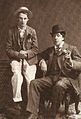 Oscar Wilde (1854-1900), with his lover Alfred Douglas. For more pictures of Oscar Wilde click here.
 -
 Robert Ross at 24 - beloved of Oscar Wilde
 -
 Greek poet Constantinos Cavafy around 1900.
 -
 Wilhelm von Gloeden (1856-1931) in 1891 (self-portrait).
 -
 Wilhelm von Gloeden (1856-1931) before 1910. From magazine Varietas n. 75, July 1910, p. 401.
 -
 Photographer Wilhelm von Plüschow (1852-1930) portraied by his cousin Wilhelm von Gloeden (1856-1931) (circa 1890).
 -
 Photographer Wilhelm von Plüschow (1852-1930) portraied by his cousin Wilhelm von Gloeden (1856-1931) (circa 1890).
 -
 Portrait of Lord Ronald Gower's lover, Frank Hird, painted by Henry Scott Tuke in 1894.
 -
 Stefan George in 1910. Picture by Jacob Hilsdorf.
 -
 Stefan George in 1910. Picture by Jacob Hilsdorf.
 -
 Hannover, Stoecken cemetery. Grave of Fritz Haarmann's victims.


.jpg)

_-_n._2415_-_Domenico_Lo_Giudice.jpg)
_-_n._2417_-_Domenico_Lo_Giudice.jpg)
,_1894.jpg)


Various / Divers / Sonstiges[edit]
-
 Frederick Rolfe (1860-1913) a.k.a "Baron Corvo", portrait of Tito Biondi, Rome, circa 1890.
 -
 Frederick Rolfe (1860-1913), male nude, 1891.
 -
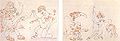 Sergei Eisenstein: Ganymede I and II, Drawing, Andrei Moskvin Collection, Moscow


