Roundel
Jump to navigation
Jump to search
Deutsch: Flugzeugkokarde oder -abzeichen bezeichnen Hoheitszeichen auf militärischen Luftfahrzeugen, die i. d. R. in den Nationalfarben gehalten sind.
English: A roundel is a distinctive mostly round logo or marking, most commonly painted on military aircraft to indicate which air force (or sometimes navy or army) they belong to.
Italiano: Una coccarda è un distintivo ottico applicato solitamente su velivoli e veicoli militari per indicarne l'apparteneza.
Nederlands: Een roundel is een onderscheidingsteken, meestal een rond logo, dat vooral op militaire vliegtuigen aangebracht wordt, zodat het duidelijk is tot welke krijgsmacht (en krijgsmachtonderdeel) het vliegtuig behoort. Zie ook Roundels van de wereld.
Polski: Oznaczenia militarne jednostek latajacych (samolotów, smiglowców, itp.), pozwalajace na identyfikacje przynaleznosci panstwowej.
Русский: Рондо — это логотип, используемый военно-воздушными силами для отличения своих воздушных судов от чужих.
Español: La escarapela aeronáutica o escarapela aérea es el emblema aeronáutico militar de nacionalidad y se utiliza en las distintas fuerzas aéreas como distintivo para indicar nacionalidad en los aviones o aeronaves.
A[edit]
-

-

-

-
-
-

-
-

-
-

-

-

-

-

-

-

-

 Algeria
1962 to 1964
As per present roundel but with green white and red horizontal bars of differing lengths -
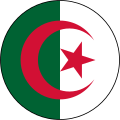 Algeria
1964 to present
Green and white vertically divided disk superimposed with red star and crescent -

-

-

-

-

-

-

-

-
-

-

-

-

-

-

-

-
-

-

-

-

-

-

-


.svg)

.svg)
.svg)
.svg)

.svg)
.svg)
.svg)
.svg)


.svg)
_%E2%80%93_Type_1.svg)
_%E2%80%93_Type_2.svg)
.svg)


.svg)
.svg)


B[edit]
-

-

-

-

-
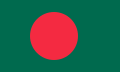
-
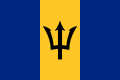
-

-
-
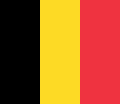
-

-

-

-

-

-

-

-
 Bhutan
Present -
 Biafra
1967 to 1970
Breakaway state from Nigeria -

-

-
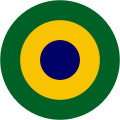
-

-

-

-

-

-
-

-

-

-

-

-

-

-

-
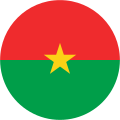
-
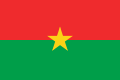
-


.svg)


.svg)
.svg)
.svg)
.svg)


.svg)


.svg)


.svg)
.svg)
.svg)
.svg)

.svg)


C[edit]
-

-

-

-
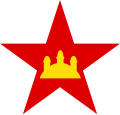
-
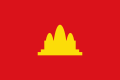
-

-

-

-
-

-
-
-
-

-

-

-

-

-
-

-

-

-

-

-
-

-

-

-

-

-
 China (ROC)
1916 to 1920 -
 China (ROC)
1920 to 1921 -
 China (ROC)
1920 to 1921
Rudder stripes -
 China (ROC)
1928 to 1990s
Kuomintang roundel used by ROCAF -
 China (ROC)
1990s to present
modified to differentiate from Kuomintang -
 China (ROC)
2010 to present
Low visibility -
 China (ROC)
2010s to present
Fin flash -
 Republic of China-Nanjing
1940 to 1945
Used by the Japanese puppet government in Nanjing -

-

-

-

-

-

-

-
-

-

-

-
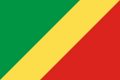
 Congo (DR)
1960 to 1964 -
 Congo (DR)
1964 to 1972 -
 Congo (DR)
2006 to present -
 Costa Rica
1948 to 1949 -
 Costa Rica
1948 to 1949
Air surveillance -
 Côte d'Ivoire
1961 to present
Basic tri-color roundel used since independence -

-
 Independent State of Croatia
1944 to 1945
Wings and fuselage. Deliberately similar to German markings -
 Independent State of Croatia
1944 to 1945
Fin flash -

-

 Croatia
1991 to 1994
Fuselage and wings
1994 to present
Fin flash
post-independance Coat of Arms, often in monochrome. -

-

-
 Cuba
Cuba
1928 to 1955
1962 to Present -
 Cuba
Cuba
1959 to 1962 -
 Cuba
Cuba
1955 to 1959 -
 Cuba
Cuba
1928 to 1955
1962 to Present
Naval aviation -
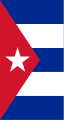 Cuba
Cuba
1928 to 1955
1962 to Present
Fin flash -
 Cuba
Cuba
1928 to 1955
1962 to Present
Fin flash (variant) -
 Czechoslovakia
1918 to 1920 -



.svg)
.svg)

.svg)
.svg)
.svg)
.svg)


.svg)
.svg)
_%E2%80%93_Navy.svg)


.svg)


.svg)


.svg)
.svg)


_%E2%80%93_National_Government.svg)


.svg)


.svg)
_(1960%E2%80%931964).svg)
.svg)


.svg)


.svg)
.svg)


.svg)


D[edit]
-
 Denmark
1916 to present
White dot on red disk -
 Denmark
1916 to present
Fin Flash, not universal -
 Djibouti
1983 to present
Used since independence -
 Djibouti
1983 to present
Fin flash
National flag is used on the fin -
 Dominican Republic
1933 to present
Crossed roundel

.svg)


E[edit]
-
 Ecuador
1920 to present
Since its foundation, Ecuador's air force has used this roundel with an exaggerated yellow band -
 Ecuador
1967 to present
Ecuadorean Navy
The Navy superimposes an anchor and eagle motif on the air force roundel -
 Egypt
Egypt
1932 to 1939 -
 Egypt
Egypt
1939 to 1945 -
 Egypt
Egypt
1945 to 1958
Post-war Egyptian aircraft carried a simple green and white roundel -
 Egypt
Egypt
1945 to 1958
Alternate -
 Egypt
Egypt
1961 to 1972 -
 Egypt
Egypt
1972 to present
In 1972, the stars were dropped from the United Arab Republic roundel (see below), and a simple three-color roundel has been used -
 Egypt
Egypt
1972 to present
Fin flash
In 1972, the new national flag was adopted as a fin flash -
 Equatorial Guinea
Modern -
 El Salvador
1922 to present
Since its foundation the air force has used a simple roundel -
 Eritrea
1994 to present
tri-color roundel -
 Estonia
1918 to 1940
1991 to present
Estonia is one of the few to use a triangular roundel -
 Ethiopia
1946 to 1974 -
 Ethiopia
1946 to 1974
(Type 2) -
 Ethiopia
1974 to 1985 -
 Ethiopia
1985 to 1996 -
 Ethiopia
1996 to 2009(?)
A three-color roundel featuring a five pointed star -
 Ethiopia
1996 to 2009(?)
(Type 2) -
 Ethiopia
2009(?) to present -
 EUFOR
EUFOR
2004 to present
Authorized, but not used on aircraft as yet -
 Eurofighter Consortium
1986 to present
This roundel combined the four participating nations (Germany, Italy, Spain, & UK) and was used on development aircraft


.svg)
.svg)

.svg)
.svg)


.svg)
_type_2.svg)
.svg)
.svg)

.svg)


F[edit]
-
 Finland
1918
Air Force
Blue swastika -
 Finland
1918
Air Force
Fin flash -
 Finland
1918 to 1945
Air Force
Blue swastika until April 1945 -
 Finland
1944 to 1945
Air Force
Low visibility version -

-

-
 Finland
1945 to present
Simple white and blue roundel -
 France
1912 to 1945
Air Force
The world's first aircraft roundel in red, white, and blue -
 France
1925 to 1945
Navy
A black anchor was superimposed over the air force roundel for naval aircraft -
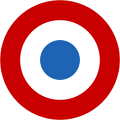 France
1945 to present
Air Force
After the war, the roundel was changed by darkening the blue and lightening the red tones -
 France
1945 to present
Navy
As before a superimposed black anchor was used for the navy -
 France
1991 to present
Navy
Low visibility
A toned down version was adopted for use on the Rafale


.svg)


.svg)


G[edit]
-
 Gabon
Gabon
1960 to present
A simple tri-color roundel has been used since independence -
 Georgia
1991 to present
A seven pointed red star inside thin blue ring -
German Empire
1914 to 1915
The initial Eisernes Kreuz (Iron Cross) for WWI Imperial German aircraft had widely flared ends -
 German Empire
1916-March 1918
The Luftstreitkräfte of Imperial Germany used this Iron Cross form for most of World War I -
 German Empire
March-April 1918
The initial form of the Balkenkreuz marked Luftstreitkräfte aircraft. -
 German Empire
April-May 1918
Idflieg established dimensions for the Balkenkreuz. Sizes were to be 400, 600 and 1000 mm. The arms were to have a length-to-width ratio of 1:4. Wing and fuselage crosses had a white border of 150mm. Photographs show that a significantly thinner border was still used on rudders, although it was also common for them to be painted entirely white and carry a plain black cross. -
 German Empire
May-June 1918
Idflieg specified a new cross design. The vertical arm was now to be full chord or fuselage depth, and the ratio of vertical to horizontal arm length was 5:4. Arm width-to-length ratio was changed to 1:8, and the width of the white border to the width of the arm was 1:4. The ends of the arms were not bordered. By this time, white rudders seem to be fairly standard among most major manufacturers. -
 German Empire
June-November 1918
dflieg’s final change to the cross design reverted to a 1:1 ratio between the vertical and horizontal arm length, maintaining all other features of the May directive. -
 Germany
1935 to 1945
The standardized Balkenkreuz used by the Third Reich's Luftwaffe aircraft to July 1939, and on upper wing surfaces for the rest of the war -
 Germany
1940 to 1945
The "wide-flank" Balkenkreuz used by the Luftwaffe on aircraft from July 1939 to May 1945 (on under wing surfaces and fuselage), and on armored fighting vehicles (AFVs) -
 Germany
1935 to 1945
Fin flash -
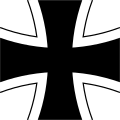 Germany
1955 to present
The modern insignia of the Bundeswehr's Luftwaffe is the Iron Cross -
 Germany (East)
1949 to 1959
Diamond roundel used on aircraft (wings/fin flash) -
 Germany (East)
1959 to 1990
Diamond roundel used on aircraft (wings/fin flash) -
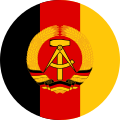 Germany (East)
1959 to 1990
Round version for Border Troops military vehicles and equipment -
 Germany (East)
1979 to 1990
Round version for military vehicles and equipment -
 Ghana
Ghana
1959 to 1964
1966 to present
A simple tri-color was adopted at independence -
 Ghana
Ghana
1964 to 1966
For a brief period the yellow was re-colored white -
 Greece
1919 to present
Simple blue and white roundel -
 Greece
1919 to present
Fin flash -
 Greece
1978 to present
Military vehicles roundel -
 Guatemala
1923 to 1939
1947 to present
Roundel is similar to the early US roundel in blue and white -
 Guatemala
1939-1947
Roundel altered to a 6-pointed star -
 Guinea
1962 to present
Tri-color roundel -
 Guinea-Bissau
1978 to present
Red disc with black five point star superimposed -
 Guyana
1968 to present
Simple three color roundel


_before_1959.svg)
.svg)
.svg)


.svg)


.svg)


.svg)
H[edit]
-
 Haiti
Haiti
1942 to 1964 -
 Haiti
Haiti
1964 to 1986 -
 Haiti
Haiti
1986 to 1994 -
 Honduras
Modern -

-

-

-
-

-
-

-

-

-

-

.svg)
.svg)
.svg)
.svg)
.svg)

.svg)
.svg)
.svg)
.svg)
.svg)
.svg)
.svg)
.svg)


I[edit]
-
 India
India
1947 to 1950
Ashok Chakra roundel used prior to India becoming a republic -
 India
India
1950 to present
Simple three color roundel -
 India
India
1947 to present
Fin flash -
 Indonesia
1954 to present
Air force aircraft have a white pentagon outlined in red -
 Indonesia
1954 to present
Army aircraft add a black or yellow five pointed star in the pentagon -
 Indonesia
1954 to present
Navy aircraft add a black anchor within the pentagon -
 Iran
Iran
1922 to present
A simple three color roundel -
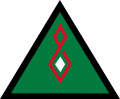 Iraq
Iraq
1931–2004
2019 to present
Stylized Arabic letter ج (for جيش "army") in triangle in Pan-Arab colors. -
 Iraq
Iraq
2011–2019 -

-
 Ireland
1939-1954
Original "Celtic Boss" roundel did not include white -
 Ireland
1922-1923
At the formation of the Irish Air Corps, a conventional roundel with the Irish colours was used -

-
 Israel
present
Low visibility version removes white background and is simply blue Star of David on fuselage -
 Israel
Early Variant
Roundel originally was surrounded by a blue ring -
 Italy
Italy
1922 to 1943
Fuselage only -
 Italy
Italy
1940 to 1943
Adopted during World War II for use upper the left wing and under the right wing -
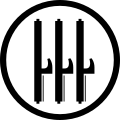 Italy
Italy
1940 to 1943
Adopted during World War II for use upper the right wing and under the left wing -
 Italy
Italy
1929 to 1943
Fin flash -
Italy (RSI)
1943 to 1944
The standardized Balkenkreuz used by the Third Reich's Luftwaffe, on upper wing surfaces until January 1944 (Italian Social Republic) -
Italy (RSI)
1943 to 1944
The "wide-flank" Balkenkreuz used by the Luftwaffe, on under wing surfaces and fuselage (next the flag tricolore) until January 1944 (Italian Social Republic) -
 Italy (RSI)
1944 to 1945
The Italian Social Republic air force wore this square insignia on the wings -
 Italy (RSI)
1943 to 1945
The Italian Social Republic air force wore an Italian flag motif on the fuselage and fin flash -
 Italy
Italy
1910 to 1922
1944 to 1989
A standard tri-color was used in World War I, and again from World War II after Italy joined the Allies -
 Italy
Italy
1990 to present
The white portion was reduced in 1990 for visibility purposes on most aircraft -
 Italy
Italy
Until 1929
Fin flash


.svg)
.svg)


.svg)
.svg)

.svg)
.svg)
.svg)
.svg)


J[edit]
-
 Jamaica
1963 to present
The Jamaican Defence Force uses a simple tri-color roundel -
 Japan
Japan
1915 to 1999
Japanese aircraft use a red disc representing the rising sun -
 Japan
Japan
1999 to present
Japanese aircraft use a red disc representing the rising sun -
 Jordan
1949 to present
Roundel of black, white, and green rings with superimposed red quarter with white seven point star

.svg)


K[edit]
-
 Katanga
1960 to 1963 -
 Kazakhstan
1991 to present
Most Kazakh aircraft have had national symbols of the sun and eagle superimposed on the red star -
 Kenya
Kenya
1964 to present
Kenya uses a tri-color roundel with thin white interspersing bands -
 Korea (North)
1948 to present
Used since the foundation of the air force -
 Korea (South)
1950s to 2000s
Based on the US roundel, using the blue and red Yin Yang symbol from the national flag -
 Korea (South)
2000s to present
The roundel was altered to better reflect the national flag -
 Kuwait
1961 to present
Kuwait uses a four color roundel, though it has rarely been applied since the 1991 Gulf War -
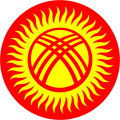 Kyrgyzstan
1991 to present
Insignia representing the sun and a yurt (tent) is used
.svg)


L[edit]
-
 Latvia
1918 to 1940
Prior to Soviet annexation, a red swastika was used -
 Latvia
1992 to present
Since regaining independence, a more traditional roundel has been used -
 Latvia
1992 to present
Fin flash
Since independence, the national flag is used as a fin flash -
 Laos
Laos
1960-1975 -
 Laos
Laos
Uncertain
Rarely used, this roundel is based on the national flag -
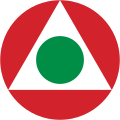
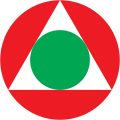 Lebanon
1949 to present -
 Lesotho
ca. 1988 to present -
 Liberia
1987 to present -
 Libya
Libya
1959 to 1969
A red, black, and green roundel with exaggerated black ring -
 Libya
Libya
1969 to 1978
A three color roundel was used during the period of close ties with Egypt -
 Libya
Libya
1978 to 2011
Wings and fuselage -
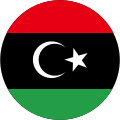 Libya
Libya
2011 to 2016 -
 Libya
Libya
2016 to present
Alternate -
 Lithuania
1919 to 1920 -
 Lithuania
1920 to 1921 -
 Lithuania
1921 to 1940
1991 to present
The Vytis cross was used before and after Soviet occupation -
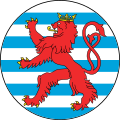 Luxembourg
1982 to present
Some NATO aircraft registered in the Grand Duchy carry this fin emblem
.svg)


.svg)
.svg)
.svg)


.svg)
.svg)


M[edit]
-
 Madagascar
1961 to present
A simple tri-color roundel, sometimes with golden border ring -
 Malawi
1970 to present -
 Malaysia
1963 to 1982
14 point gold star on a blue square with black (sometimes dark blue) outline -
 Malaysia
1982 to present
In 1982 the roundel was changed from a square to a circle -
 Malaysia
1982 to present
Another uncommon variant, rarely used -
 Malaysia
Present
Fin Flash -
 Maldives
Present -
 Mali
Mali
Present -
 Malta
Malta
1992 to present
A George Cross within a red disk -

-
 Manchukuo
1935 to 1945
Manchukuo Air Transport Company roundel -
 Mauritania
1960 to 2019
A golden star and crescent on a green field have been used since independence -
 Mauritania
1960 to 2019
Fin flash -
 Mauritania
2019 to present -
 Mauritania
2019 to present
Fin flash -
 Mauritius
Present -
 Mexico
1922 to present
Mexico uses a triangular three color roundel -
 Mexico
1926 to present
Naval aviation -
 Moldova
1991 to present -
 Moldova
Usage uncertain
Alternative Moldovan roundel -
 Mongolia
1940-1992
A Soviet roundel was used during the Communist regime for wings and fuselage -
 Mongolia
1940-1992
Soyombo symbol in red as fin flash -
 Mongolia
1992-present
New roundel with national flag colors -
 Mongolia
1992-present
Soyombo symbol, in yellow as fin flash -
 Montenegro
2006 to present -
 Morocco
1956 to present
A gold crown and green star on a red disc ringed in green -
 Mozambique
1975 to present
Roundel incorporates Marxist symbols has been used since independence -
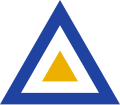 Myanmar
1955 to present
A triangular insignia in blue, white, and gold (a pun on the 'Golden Triangle')


.svg)


.svg)

_%E2%80%93_Manchukuo_Air_Transport_Company.svg)
.svg)
.svg)


.svg)
.svg)

.svg)

.svg)

.svg)

N[edit]
-
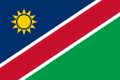 Namibia
 -
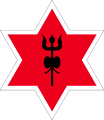 Nepal
Nepal
Modern
Used by Nepalese Army aircraft -
 Netherlands
1914 to 1921 -
 Netherlands
1921 to 1939
1945 to present
A pie shaped three color roundel with an orange dot in the center -
 Netherlands
1939 to 1941
As a symbol of neutrality, the Dutch adopted an orange triangle outlined in black until German invasion -
New Zealand
1923 to 1942
1947 to 1970
Matched RAF standard markings -
 New Zealand
1944 to 1945
American style bars were added to the RNZAF insignia late in the war -
 New Zealand
1970 to present
The standard RNZAF roundel incorporates a red kiwi (bird) within a blue ring -
 New Zealand
1989 to present
Low visibility
Blue and red version for combat aircraft -
 Nicaragua
1936 to 1979
Blue outlined white triangle, within a blue and red roundel -
 Nicaragua
1979 to present
Sandinista colors with a superimposed gold star, on a gold circle with a black outline -
 Niger
Niger
1961 to 1980
A pie shaped three color roundel of orange, white, and green with a central orange disc -
 Niger
Niger
1980 to present
Horizontal tri-color roundel of orange, white, and green with a central orange disc -
 Nigeria
1964 to present
Green/white/green roundel -
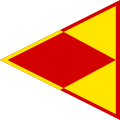 North Macedonia
 -
 Norway
1915 to 1945
Up through WWII, stripes in the national colors were painted chordwise on the wings and vertially on the rudder -
 Norway
1945 to present
Stylized red and blue aircraft motif within a blue ring


.svg)

.svg)


.svg)
.svg)
.svg)


O[edit]
-
 Oman
Oman
Modern
The national emblem on a white-bordered red disc -
 Oman
Oman
Modern
Alternative roundel in blue -
 Oman
Oman
Fin flash -
 Ottoman Empire (Turkey)
1909 to 1918
A white-bordered black square -
 Ottoman Empire (Turkey)
1909 to 1918
Rudder marking
Red field with white star and crescent similar to flag
.svg)
.svg)


P[edit]
-
 Pakistan
1947 to present
A two color green and white roundel -
 Panama
1964 to present
National flag in shape of roundel and bars -
 Papua New Guinea
1975 to present -
 Paraguay
1945 to present -
 Paraguay
1945 to present
Fin flash -
 Peru
Peru
1922 to present
A simple red-white-red roundel used on aircraft and ground equipment. -
 Philippines
1945 to present
Red, white, and blue diamond insignia with white wings outlined in blue -
 Poland
1918 to 1920
Red and white checkerboard -
 Poland
1920 to 1993
Red and white border reversing main checkerboard added -
 Poland
1920 to 1993
A variant with an additional red border around the insignia -
 Poland
1960 to 1980
Armored vehicle marking
Variant of the aircraft insignia for vehicle use -
 Poland
1993 to present
Insignia flipped for current state -
 Poland
1989 to present
Polish border guard roundel -
 Portugal
1915 to 1916
Initial roundel was a simple two-color roundel in the national colors -
 Portugal
1916 to present
Stylized red cross on a white disc -
 Portugal
Recent years
Low visibility


.svg)
.svg)


Q[edit]
-
 Qatar
Qatar
1974 to present
A simple three color roundel is used

R[edit]
-
 (Southern) Rhodesia
1935 to 1940 -
 (Southern) Rhodesia
1947 to 1954 -

1954 to 1963 -
 Rhodesia
1963 to 1970 -
 Rhodesia
Zimbabwe-Rhodesia
1970 to 1980 -
 Romania
1912 to 1941
1944 to 1947
1985 to present
Simple tri-color roundel has repeatedly been used on Romanian aircraft -
 Romania
1947 to 1985
Soviet roundel used during the Communist era. -
 Romania
1941 to 1944
During WWII an outlined cross was used with a roundel imposed on the center -
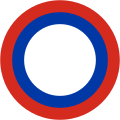 Russia
1915 to 1917
Various proportions used, many with enlarged center white disk, and some with white rings separating each color -
 Russia
1918 to 1922
Simple red star -
 Russia
1992 to 2010 -
 Russia
2010 to present -
 Rwanda
Current
A four ring roundel of yellow, red, yellow, and green

.svg)
.svg)
.svg)
.svg)

.svg)


.svg)


S[edit]
-
 Saudi Arabia
1933 to present
A green, white, green roundel with exaggerated center disc with emblem superimposed -
 Senegal
1961 to present
A green star on yellow disc with red wings -
 Serbia
2006 to present
The Serbian Air Force and Air Defense adopted this insignia, reflective of the pre-WWII Yugoslav insignia -
 Serbia
2006 to present
Low-visibility Version -
 Serbia & Montenegro
2003 to 2006
The 'Pepsi' roundel with blue upper and red lower sections broken by a horizontal wide white stripe -
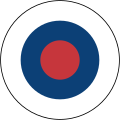 Serbia
1915 to 1918 -
 Serbia
1912 to 1915
Serbian national marking was created by replacing the white of the original French markings with blue -
 Serbian Krajina
1993 to 1995 -
 Seychelles
1978 to present
Coast Guard Aviation insignia -
 Sierra Leone
1993 to present
The official roundel is a simple tri-color in light tones -
 Singapore
1968-1973
A Red-White-Red roundel was used, similar to Peru and Turkey's roundels -
 Singapore
1973-1990
A Ying-Yang symbol with spiral speed lines -
 Slovakia
1993 to present
The Coat of Arms of the Republic is used as the Air Force Roundel -
 Slovakia
Present
Low-visibility version -
 Slovakia
1993 to present
A square version of the Coat of Arms is used for vehicles and ground equipment -
 Slovakia
1941 to 1945
A blue balkenkreuz with a red disc at the center -
 Slovenia
1918 to 1919
1996 to present
Simple tri-color roundel, with a white outer ring -
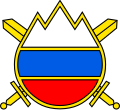 Slovenia
1991 to 1996 -
 Somalia
1961 to present
A white 5 pointed star on a blue disc -
 South Africa
1920 to 1921
Trial version -
 South Africa
1921 to 1927 -
 South Africa
1927 to 1947
A simple roundel based on the RAF roundel, but with the red replaced by orange -
 South Africa
1947 to 1957
Like the previous roundel, but with a springbok replacing the orange disc -
 South Africa
1958 to 1981 -
 South Africa
1982 to 2003 -
 South Africa
2003 to present
A blue disc with superimposed nine point fort (representing the nine provinces of South Africa) and golden eagle -
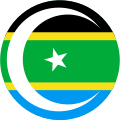 South Arabia
1963 to 1967 -

-
 Spain
Spain
1918 to 1931
1942 to present
A red, yellow, and red roundel, sometimes with an exaggerated middle ring -
 Spain
Spain
1931 to 1939
A red, yellow, and purple representing the Spanish Second Republic Flag -
 Spain
Spain
1936 to 1939
Spanish Republican Air Force; Civil War roundel for wings and fuselage -
 Spain
Spain
1931 to 1939
Spanish Republican Air Force
Fin Flash -
 Spain
Spain
1931 to 1936
Spanish Republican Air Force
Spanish Republican Navy Naval Aviation fin flash -
 Spanish Nationalist Air Force
1936 to 1939
A white X on a black disc on wings -
 Spanish Nationalist Air Force
1936 to 1939
A black disc on wings and/or fuselage -
 Spanish Nationalist Air Force
1936 to 1939
Fuselage -
 Spanish Nationalist Air Force
1936 to 1939
Fuselage -
 Spanish Nationalist Air Force
1936 to 1939
Fin Flash -
 Spanish Nationalist Air Force
1936 to 1939
Fin Flash (low visibility) -
 Sri Lanka
1950 to 2010
A maroon and yellow roundel with orange and green bars -
 Sri Lanka
2010 to present -
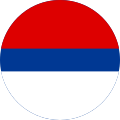 Republika Srpska
1992 to 2006 -
 Sudan
Sudan
1956 to 1970 -
 Sudan
Sudan
1970 to present
A red, white, and black roundel with green quarter field -
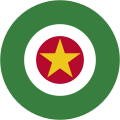 Suriname
1983 to present
A green, white, and red roundel with superimposed yellow star -
 Sweden
1914/15
Original twotone roundel -
 Sweden
1927-1937
A new roundel of 3 black crowns was adopted -
 Sweden
1937-1940
Colour was added in 1937 -
 Sweden
1940 to present
A gold ring was added in 1940, and this roundel has been retained to today -
 Sweden
1990 to present
Low visibility
Sweden uses a low visibility version for combat aircraft -
 Sweden
Fin Flash -
 Switzerland
1914 to 1945
similar to the Swiss flag -
 Switzerland
1945 to present
A white cross on a red disc replaced the wartime wing striping -
 Syria
Syria
1948 to 1958
1961 to 1963 -
 Syria
Syria
1963 to 1972 -
 Syria
Syria
1972 to 1980
Syria adopted an identical roundel to Egypt and Libya when they formed the Federation of Arab Republics -
 Syria
Syria
1980 to present


.svg)


.svg)
.svg)


.svg)


.svg)

.svg)
.svg)
.svg)
.svg)

.svg)


.svg)


.svg)


.svg)


.svg)
_%E2%80%93_Type_1.svg)
.svg)


.svg)
.svg)
.svg)

T[edit]
-
 Tajikistan
1992 (?)
Soviet style roundel -
 Tanzania
1964 to 2010
White, blue or yellow torch and wreath on a green disc, sometimes bordered in blue -
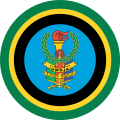 Tanzania
2010 to present -
 Thailand
1917 to 1940
1945 to present
A five-ring roundel based on the national flag, was not in use during WWII -
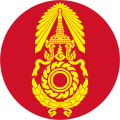 Thailand
? to present
Roundel of Army Aviation -
 Thailand
1941 to 1945
The "running Elephant" is a version of the former Flag of Siam before the November 28 1917 -
 Thailand
1941 to 1945
Fin flash -
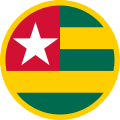 Togo
Togo
1960 to present
A round variant of the national flag, bordered in gold -
 Transnistria
1991 to present
Based on flag -
 Tunisia
1960 to present
A red crescent and star on a white disc, bordered in red -
 Turkey
1918 to 1972
White-bordered red square -
 Turkey
1918
1972 to present
Red-white-red roundel -
 Turkmenistan
1992 to present


.svg)


.svg)
.svg)


.svg)


U[edit]
-
 Uganda
1964 to present
Black, yellow, red, and white with enlarged white disc superimposed with a crested crane motif -
 Uganda
1964 to present
Type 2 -
 Uganda
1964 to present
Type 3 -
 Ukraine
1919 and 1992 to present
Yellow and sky blue -
 Ukraine
1991
Reversed colours used briefly after independence -
 Ukraine
1991 to present
Black anchor superimposed for navy aircraft -
 Ukraine
1991 to present
Coat of arms used as fin flash -
Union of Soviet Socialist Republics
1922 to 1945
Simple red star -
Union of Soviet Socialist Republics
1945 to 1991
Red star with a white outline -
 United Arab Emirates
1976 to present
In 1976 the Emirates all began using a single roundel -
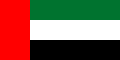 United Arab Emirates
1976 to present
Fin flash
National flag used as fin flash -
United Arab Republic
1958 to 1971
A red, white, and black roundel with two green stars in the white ring -
 United Kingdom
Royal Flying Corps
1914
Fin flash, short-lived due to confusion with German Iron Cross from distance -
United Kingdom
Royal Air Force
1915 to 1947
Red, white and blue roundel -
United Kingdom
1947 to present -
United Kingdom
1939 to present
Fin flash
Used as rudder stripes before 1935 with colours reversed before 1929 -
 United Kingdom
1918 to present
Low visibility
white removed to reduce visibility, proportions of 2:5 or 1:2. -
United Kingdom
1942 to 1945
Yellow omitted on wings -
United Kingdom
1942 to 1945
Fin flash -
 United Kingdom
1942 to 1945
Far East Command
Red removed to avoid confusion with Japanese markings in SE Asia -
 United Kingdom
1944 to 1945
Fleet Air Arm in Pacific operating with US task forces -
 United Kingdom
1985 to present
Low visibility -
 United States
1918 to 1919
American Expeditionary Force
Three-tone red, blue, and white roundel used only in Europe -
 United States
1919 to 1942
Revised roundel with smaller red disc -
 United States
USAAC
1919 to 1942
rudder stripes -
 United States
United States Navy
1927 to 1942
rudder stripes -
 United States
1942 to 1943
Red disc removed to reduce confusion with Japanese markings -
 United States
March 1943 to September 1943
White bars and red outline added, short-lived due to confusion with Japanese markings -
 United States
1943 to 1947
Outline changed from red to blue -
 United States
1947 to present
White star on a blue disc with blue, white, and red bars -
 United States
1990 to present
Low visibility -
 United States
1942-1945
Five-pointed white star (type 1): military vehicles. -
 United States
1942-1945
Five-pointed white star (type 2): military vehicles. -
 Uruguay
1916 to present
Based on military cockade but with horizontal stripes -
 Uzbekistan
1992 to present


.svg)

.svg)


.svg)


.svg)
.svg)


.svg)
.svg)
.svg)


_type_1.svg)
_type_2.svg)


V[edit]
-
 Venezuela
1956 to present
Horizontal bars added in 1956 -
 Vietnam (South)
1951 to 1955
Three red rings on yellow disc -
 Vietnam (South)
1955 to 1975
Similar to US roundel, but bordered in red and with white bars in yellow -
 Vietnam (South)
1955 to 1975
Fin flash -
 Vietnam (North)
1955 to 1965
A yellow star with red border -
 Vietnam
1959 to present
A yellow star on red disc with red bars bordered in gold -
 Vietnam
1959 to present
Military vehicles: a yellow star on red disc

.svg)
.svg)

.svg)


Y[edit]
-
 Yemen (Kingdom)
1957 to 1962
Red-white-red roundel with stars and sword in centre -
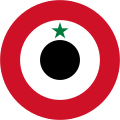 Yemen (North)
1962 to 1990
Red, white, and black roundel with green star centered at top of white ring -
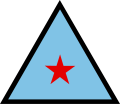 Yemen (South)
1967 to 1990
Blue triangle superimposed with red star -
 Yemen
Yemen
1990 to present
Red, white, and black roundel -
 Yugoslavia (Kingdom)
1923 to 1929
Yugoslavia's first roundel was blue and white with a Serbian Cross -
 Yugoslavia (Kingdom)
1929 to 1941
In 1929 red was added so that all three national colours were included -
 Yugoslavia (Kingdom)
1923 to 1941
Fin Flash -
 Yugoslavia (Democratic Federal)
1943 to 1946
Wings -
 Yugoslavia (Democratic Federal)
1943 to 1946
Fuselage (type 1) -
 Yugoslavia (Democratic Federal)
1943 to 1946
Fuselage (type 2) -
 Yugoslavia (Democratic Federal)
1943 to 1946
Fin flash -
 Yugoslavia (Socialist Republic)
1946 to 1992
Wings and fuselage -
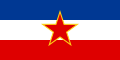 Yugoslavia (Socialist Republic)
1946 to 1992
Fin flash -
Yugoslavia (Republic)(Serbia and Montenegro)
1992 to 2006
Based on national flag with a narrow white stripe -
 Yugoslavia (Republic)(Serbia and Montenegro)
1992 to 2006
Fin Flash
.svg)
.svg)
.svg)


;_Type_1.svg)
;_Type_2.svg)
;_Type_3.svg)
.svg)

.svg)
;_Serbia_and_Montenegro_(2003%E2%80%932006).svg)
Z[edit]
-
 Zaire
Zaire
1971 to 1977? -
 Zaire
Zaire
1977? to 1997 -
 Zaire
Zaire
1971 to 1997
Fin flash -
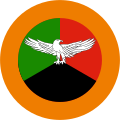 Zambia
1964 to present
Since independence, Zambia has used a three-color roundel with an orange outer band superimposed with an eagle -
 Zimbabwe
1994 to present
A five ring roundel of green, yellow, red, black, and white

.svg)
.svg)


[edit]
-
 Mystery Tri-Color
 -
 Mystery Two-Color
 -
 How to paint a USAF roundel


