Commons:Copyright rules by subject matter


This page brings together a variety of subjects and aims to answer the question "Do copyright laws allow the upload of pictures of […]?".
It is  OK to upload:
- Photos you have taken yourself of uncopyrightable subjects such as views, nature, and people.
- Photos taken by you or scans or photocopies made by you of objects or designs whose copyright has expired (usually 70 years after the death of the author, but see Commons:Copyright rules by territory for a country-by-country list).
- Mere mechanical scans or photocopies, made by somebody else, of an object or design old enough to be in the public domain (usually 70 years after the death of the author, but see Commons:Copyright rules by territory for a country-by-country list). For scans of old images that may have been enhanced, see Commons:When to use the PD-scan tag.
- Photographs, taken either by yourself or someone else, that are faithful reproductions of 2D public domain works of art. See Commons:When to use the PD-Art tag.
(Note that other Commons policies and guidelines, covering issues such as scope and personality rights, still apply.)
Other subjects may or may not be allowable – see headings below. If you want to have an answer to the question "Can I upload photographs/pictures from ...?", see the section on Internet images. See also: Commons:Threshold of originality.
Advertisement[edit]
 Not OK General rule.

OK Exceptions: In the United States, advertisements published in collective works (magazines and newspapers) are not covered by the copyright notice for the entire collective work. (See U.S. Copyright Office Circular 3, "Copyright Notice", page 3, "Contributions to Collective Works".) This is because the same advertisement will often run in many publications. (See U.S. Code title 17, chapter 4.) Note that this rule does not apply to advertisements whose copyright belongs to the publisher of the collective work, such as ads for another magazine subscription. It also does not apply to advertisements first published outside the United States.
Works published in the U.S. without a valid copyright notice before 1978 automatically fell into the public domain. Thus, magazine and newspaper advertisements published in the United States before 1978 without a separate copyright notice may be uploaded to Commons with a {{PD-US-no-notice}} tag. Advertisements published since 1978, but before March 1989, may also be uploaded as {{PD-US-1978-89}} if they have no separate copyright notice and if their copyright was not registered with the U.S. Copyright Office within 5 years of publication. (For U.S. works published since March 1989, a copyright notice has no longer been required for copyright protection.)
It is best to avoid advertisements that include notable artwork that may have been covered by copyrights — there have been cases where companies ran ads with images they did not own. Advertisements published in the U.S. that have a simple photograph of a product, such as a 1950s washing machine, will make a good illustration for early home appliances and would be very unlikely to be encumbered by copyright.
Album covers[edit]
Not OK Album covers (LP, CD, DVD, video cassettes, and so on) almost always carry copyright-protected designs, and photographs of them may not normally be uploaded to Commons. Physical ownership of an album merely licenses private broadcasts of the album's contents and does not transfer copyright ownership to the consumer. Please note that there is no fair use at Commons since we only have free media.
OK Exceptions: Covers released under a free license or in the public domain. Covers may be in the public domain due to age, simplicity or other ineligibilities.
-
 Freely licensed under {{CC-BY-2.0}}
 -
 Public domain per {{PD-US-no notice}}
 -
 Public domain per {{PD-US-not renewed}}
 -
 Public domain per {{PD-textlogo}}
 -
 Public domain per {{PD-textlogo}}
 -
 Public domain per {{PD-textlogo}}
 -
 Public domain per {{PD-USGov-Military-Navy}}
 -
 Public domain per {{PD-medical}} (added text is in the public domain per {{PD-text}})


.png)
Antiquities[edit]
OK
Some countries (like Mexico, Italy, Greece or Egypt) have laws which allow them to control the publication of pictures of protected archaeological sites or heritage items. These are ignored at Commons as they are considered as non-copyright restrictions.
Architecture[edit]
- See Commons:Freedom of panorama and Buildings below.
Art (copies of)[edit]

2D art (paintings etc.)[edit]
If the original artwork remains in copyright a license from the artist is nearly always needed. Mere physical ownership of an original artwork such as a painting does not confer ownership of the copyright: that remains with the artist.
There are a few rare situations where the artist's license may not be needed:
- Certain images permanently located in a public place, in some countries: See Commons:Freedom of panorama.
- Graffiti: see Graffiti. Note that graffiti is not the same as murals.
If the original artwork is old enough to be in the public domain it is OK to upload a scan or a photocopy (from any source) or a photograph you have taken yourself. A faithful photographic copy of a public domain 2D artwork such as a painting may always be uploaded to Commons, even if the photograph was taken by somebody else and even if no photographer's licence has been provided: see Commons:When to use the PD-Art tag
- See also Engravings.
3D art (sculptures etc.)[edit]
If the original artwork remains in copyright a license from the artist is nearly always needed. Mere physical ownership of an original artwork such as a sculpture does not confer ownership of the copyright: that remains with the artist. In some countries a 3D artwork that is permanently located in a public place can be photographed and the image uploaded without the artist's permission: See Commons:Freedom of panorama. If the 3D artwork is old enough to be in the public domain, you may upload a photograph you have taken yourself. If the photograph was taken by somebody else, you need the photographer’s permission, since the photograph is copyright-protected, despite depicting art that is not.
- Wax sculptures
Not OK Wax sculptures or wax figures are usually copyrighted and not permanently located in a public place. See Category:Wax figure deletion requests.
Banknotes[edit]
- See Commons:Currency
Board games[edit]
Not OK

Board games are usually of copyright design, and photographs that are intended to illustrate the game board and/or the box are not normally acceptable. Photographs of a game in progress may possibly be allowable provided that the copyright elements are incidental and de minimis to the overall image, but that is unlikely to be the case if the whole board or box design is clearly shown. The design shown does not automatically become incidental simply because there are some players in the frame along with the board.
OK Exceptions: Old board games such as backgammon, chess and go are allowable unless the board incorporates some original artistic design. Monopoly is also a special case: the 'original' Monopoly board is now out of copyright - it was published in a US patent application back in 1935: see w:Image:DarrowPage1.png. Modern standard sets may be shown provided that they are substantially identical in design to the original. Sets with significant new design elements, such as Monopoly Junior, are not allowed since the new design elements will be entitled to a new copyright.
Book covers[edit]
- Not OK General rule.
- OK Exceptions: Old books and very simple design: File:Thilo Sarrazin - Deutschland schafft sich ab. Cover.svg.
- OK Exceptions: Book covers illustrated only with public domain work: File:Angelika Kauffmann- Bildnismalerei im 18. Jahrhundert book cover.gif


Book covers, unless they are very old (see Commons:Licensing: Material in the public domain), usually carry copyright-protected designs, and photographs of them may not normally be uploaded to Commons. The fact that you are the physical owner of a book does not mean that you are authorised to replicate the cover design by uploading a copy here. A rare exception to this rule would be a book cover which is simple enough to not exceed the Threshold of originality.
Buildings[edit]
Photographs of buildings are normally allowed if the building is old enough to be public domain (in many countries, where the architect has been dead for at least 70 years). Photographs of more recent buildings may be restricted because of the architect's copyright, though some countries have exceptions that allow photographs to be taken of any building in a public place. See Commons:Freedom of panorama. Buildings constructed before December 1, 1990, are not protected by copyright in the United States.
CD covers[edit]
- See Album covers.
Characters from books and films[edit]
See also:
- Commons:Fan art
- Commons:Derivative works#What about images of copyrighted characters in public domain works?
Cheques[edit]
See Commons:Cheque.
Clothing[edit]
OK Images illustrating clothing styles or articles of clothing are normally acceptable. The copyrightability of fashion varies by country. For example, in the United States, fashion is not copyrightable,[1] while in France it is.[2] (See Star Athletica, LLC v. Varsity Brands, Inc. for further information on U.S. law.) In any case, care must be taken not to infringe the copyright of any printed or woven design that may appear on the clothing's surface. So, for example, you cannot upload images of T-shirts or caps displaying a copyrighted cartoon character; see Comic and action figures.
See also:
Coats of arms[edit]
You should assume that a coat of arms drawn by someone else is copyright-protected unless you can demonstrate to the contrary. Even if the elements making up the arms have been used for hundreds of years, each specific realization may have sufficient originality to attract copyright protection. Direct copies of such specific realizations cannot therefore be uploaded even if you have taken the trouble to trace or even re-draw the design yourself.
However, if you can establish that the specific realization you want to use is old enough to be out of copyright, it is OK to upload. It is also OK if you can establish that the specific realization differs from an old public domain realization only by immaterial details that in themselves are not sufficiently creative to generate a new copyright.
- See also Commons:Coats of arms and Copyright on emblems.
For a relevant legal discussion from a US perspective, see Wikilegal/Flags and logos from international organizations.
Coins[edit]
- See Commons:Currency and Commons:When to use the PD-Art tag: Photograph of an old coin found on the Internet.
Collages[edit]
- As far as possible, upload each source image as a standalone image with suitable source and licensing information.
- Finally, upload the collage using the "derivative work of one or several files from Commons" option at Commons:Upload
- Or you may add every source information manually: see File:Collage of Six Cats-01.jpg, for example.
Comic and action figures[edit]
Not OK No photographs, drawings, paintings or any other copies/derivative works of these are allowed (as long as the original is not in the public domain or freely licensed). No pictures are allowed of items which are derivatives from copyrighted figures themselves, like dolls, action figures, T-shirts, printed bags, ashtrays etc.
- See also Commons:Fan art
Concert photography[edit]
OK Photographs you've taken yourself at concerts are believed to be acceptable. We believe such photos are not covered by the performing artists' related (neighbouring) rights (see this discussion). Nevertheless: ideally, you should be able to present an explicit permission by the performer to take and publish photos. Beware of concert photos showing an artistic stage design: such photos are not ok, as they may infringe the stage designer's copyright. Close-ups of performing artists should be fine, though. On the other hand, you should be aware that uploading concert photographs here may infringe terms which you agreed to when purchasing the ticket or as a condition of entry.
- See also: Practical tips on concert photography
- On concert photographs found on other web sites, see Commons:Problematic sources: Fan sites.
Costumes and cosplay[edit]
Determining whether a photograph of a costume or cosplayer is a copyright infringement is complex. Some widely-agreed upon points:
- Regardless of the copyright status of the depicted costume, the photograph of it also must have been released under a free license by its copyright holder (usually the photographer).
- If the costume is a completely original design (not based on any existing character design), and the designer has released it under a free license, it is permitted. (There isn't a tag for this at the moment.)
- If the costume is an accurate representation of a character whose design is released under a free license or in the public domain, it is permitted.
- If the costume is a modified or original representation of a character whose design is released under a free license or in the public domain, and the costume designer has also released their design under a free license, it is permitted.
- If the costume is purely utilitarian and has no distinct or original graphical features - for example, if it's the kind of clothing that an ordinary person might wear on the street or on the job - then it is permitted under #Clothing above.
- If the costume is not the central focus of the image but only an incidental feature, or one among many costumes, it is likely to be considered de minimis.
In 2011, the Wikimedia Foundation issued the following statement regarding costumes, intended to supplant earlier advice given by Mike Godwin:
- "This is a complex and difficult issue, which in the end comes down to the decision of individual contributors. Although we cannot offer legal advice in particular cases, we can provide these general thoughts. In short, both costumes and masks are copyrightable. Additionally, posting pictures of costumes or masks that are themselves under copyright, or which depict characters that are under copyright could qualify as copyright infringement (subject to a fair use analysis).
- The 1991 policy decision on costumes and masks by the Copyright Office appears to still be in effect, and although it is only advisory, it is a good indication of where courts tend to fall on this issue. It says that masks are definitely copyrightable, and that costumes may be copyrightable in certain circumstances (or at least certain features of the costume might be copyrightable), subject to a complicated legal analysis to determine whether the aesthetic aspects of the costume are "separable" from the costume's role as an article of clothing (the utilitarian aspects). Some information on the separability test can be found at [1] [link replaced with archived copy].
- The separability test is an unfortunate example of where American law can get rather confusing, as the outcome may differ from court to court. However, the important thing for us to keep in mind is that if someone obtains a copyright for either the character that is being depicted by the costume, or obtains a copyright for the costume or mask itself, she could send us a DMCA takedown notice for any photograph of a costume or mask depicting that character (as it could be considered a derivative work), and the individual who posted the image could also be liable for copyright infringement. This is similar to the "Mickey Mouse action figure" example at Commons:Derivative works, which demonstrates that reproducing a 3D copyrighted work in 2D (or vice-versa) is not sufficient to escape liability.
- The separability test is legally complex, and because it is performed only once a matter goes to court, the outcome is uncertain. The same is also true of the “fair use” defense, which is often regarded as a dangerous and expensive defense to rely on. The safest approach is to assume that if a costume depicts a character that is under copyright, or if the costume itself is produced by a company that is likely to have placed it under copyright, posting photographs of it may result in a DMCA takedown notice, and possible liability to the individual who posted it.
- --Wikimedia Foundation legal team"
However, the community has not accepted this strict view, partly in light of Ets-Hokin v. Skyy Spirits, in which a photograph of a bottle was held not to be derivative of the label on the bottle. Present consensus is that "files that merely show people cosplaying" are acceptable.[3]
- Costumes that may *not* be eligible for copyright protection
-
 (Decided here) "kept per Mike Godwin"
 -
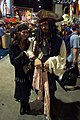 (Decided here and here) "kept per Mike Godwin"


Covers[edit]
- See Album covers and Book covers.
Currency[edit]
- See Commons:Currency
Drawings based on photographs[edit]
Photographs can be copyrighted. A drawing made from a copyrighted photograph is a derivative work; such a drawing can be published only if the copyright owner of the underlying photograph has given his express consent. The artist of the drawing also has a copyright on all aspects original to his or her drawing. If the base photo is in the public domain, there's only the copyright of the artist of the drawing to consider. If you want to upload a drawing made by someone else based on a copyrighted photo, you thus need both the photographer's and the artist's consent. If you yourself have made a drawing based on a copyrighted photo, you need the permission of the photographer before uploading your drawing here.
Drawings based on several photos are derivative works of all of them, and permission from the authors of all copyrighted photos would be needed. However, see Commons:Deletion requests/File:KGerstein.jpg: the drawing can be inspired by the photos or the photos used to get to know the likeness of the subject without the drawing being a derived work. The same also applies to paintings done after photographs, or drawings and paintings done based on other drawings or paintings, and even to drawings or paintings done directly after a 3D sculpture: all are derivative works, and in all cases the copyright of the underlying original needs to be considered. It also applies to collages. See also Art (copies of).

Engravings[edit]
Engravings are original works and subject to copyright. If an engraving is done after a pre-existing work, the engraving is a derivative work. If so, one needs not only to account for the engraver's copyright but also for that of the creator of the underlying work. An engraver may get a copyright even if he produces an engraving of a public domain original.[2] The choices made by an engraver of where exactly to place his engraved lines, how to space them, etc. are sufficient to make an engraving pass the threshold of originality. This also applies to etchings or woodcuts.
In the UK, engravings have been copyrighted since 1734, when the Engravings Copyright Act (8 Geo. 2 c. 13) was passed (amended in 1767 to also cover engravings done after pre-existing works). In the U.S., Burrow-Giles Lithographic Co. v. Sarony (111 U.S. 53 (1884)) held that when the law said it applied to "maps, charts, and writings", the term "writings" subsumed "all forms of writing, printing, engraving, etching, &c. ...". Alfred Bell & Co. v. Catalda Fine Arts, Inc. (191 F.2d 99 (2d Cir. 1951)) upheld copyrights on mezzotint reproductions of paintings that were in the public domain.
Fan art[edit]
Educationally-useful fan art can be accepted on Commons provided it has not been copied from any creative element of the original copyright work such as a movie, TV show, comic book or computer game. For more details, see Commons:Fan art.
Fireworks displays[edit]
OK According to the Berne Convention, a work can be protected by copyright only when it is written or recorded on a fixed medium. Since a firework display in action is not so recorded it does not in itself attract protection, and such displays can be freely photographed (but not necessarily filmed). The photograph will attract protection as an original photographic work, with the copyright normally owned by the photographer. So, if you have taken such a photograph yourself, you can freely upload it.
Flags[edit]
- See Coats of arms
Folklore and tradition[edit]

OK General rule
In most countries, such as Germany, works of folklore and traditional works aren't covered by copyright as long as they do not exceed the threshold of originality.(citation needed)
Not OK Exceptions: In some countries, such as Malawi, works of folklore are copyrighted by the government in perpetuity, and are thus never public domain.
Fonts[edit]
Food[edit]
OK In most cases, the presentation of food as such is not copyrightable. However consensus on Commons has generally found that artistic presentations, including food-based sculptures and cake decorations, despite their inherent impermanence, may be copyrighted if they are sufficiently original. (See, for example, Commons:Deletion requests/Images in Category:Butter sculptures.)
Gardens[edit]
Unlike natural settings, which are not copyrightable because they lack human creativity, living gardens are sometimes copyrightable, depending on the jurisdiction. In some countries, such as the US, living gardens have been held uncopyrightable ([3]), while in Germany they are copyrightable ([4]).
Graffiti[edit]
Graffiti are essentially murals that have been painted illegally. Photographs of graffiti have long been allowed on Commons. As artistic works, copyright in graffiti will theoretically belong to the original artist. However, in many cases the artist is unknown, proof of authorship of the art is problematic, and, some believe, the artist would have difficulty enforcing their copyright since that would require a court to uphold the validity of an illegal act as the basis for damages or other relief against a third party.
Graffiti may be in the public domain if painted without a copyright notice in the United States before 1978 (use {{PD-US-no notice}}). (A PD graffiti example.) Reproductions may be permitted in a few nations that have freedom of panorama for 2D works, including Croatia, Cuba, Egypt, Germany, Serbia, and the Czech Republic. For all other works, use the {{Non-free graffiti}} tag.

For legally-painted artworks, see Murals.
| Legal basis and links to relevant discussions |
|---|
|
Household objects[edit]
- See Utility objects
Internet images[edit]
The vast majority of images found on the internet are copyright-protected and may not be uploaded. The fact that an image has been posted to a publicly-available website does not give you implied permission to re-use it nor to upload it here. Many websites are silent on copyright issues, but images on those sites are just as off-limits as those on sites which explicitly say "Copyright, all rights reserved". Works are copyrighted by default in most countries due to their agreement with the Berne Convention; a copyright notice or a © sign is not needed.
Some specific sites are listed at Public domain image resources, Problematic sources and Bad sources.
Public domain images[edit]

Images that are verifiably old enough to be out of copyright can be copied and uploaded: generally when the author has been dead for at least 70 years, but see Commons:Licensing for country-by-country rules. The copyright must have expired in your jurisdiction, the United States and the jurisdiction of the web server.
Some websites incorrectly claim copyright protection on old images that are actually in the public domain ("copyfraud"). You should critically analyze such statements and not simply take them at face value.
In many European countries there is a separate copyright-like publication right for previously unpublished works out of copyright. In the European Union the first publisher gets 25 years of exclusive rights to distribute copies of the work.
Images released under a free license[edit]
Images that have been verifiably released under an acceptable Free license by the copyright owner can be copied and uploaded. The image must be free in your jurisdiction, the United States and the jurisdiction of the web server.
Note that the website owner normally does not own the copyright to images on the website. Many amateur and even some professional websites purport to release rights that they do not own, for example by incorrectly stating that all images on the site are public domain. You should critically analyse such statements and not simply take them at face value.
In a few countries, notably the USA, most government-created works are as a matter of policy released into the public domain; please use the appropriate template such as {{PD-USGov}}. Additional specific templates for US government agencies and offices can be found in Category:PD-USGov license tags.
- See also: Wikilegal/Copyright Status Of Images Hosted On US Government Websites and images created by NASA.
In many countries, certain types of government-created works are in the public domain. This typically includes at least legislation, but related works, such as the design of traffic signs, may be included.
Copyright-ineligible images[edit]
Images that are not of sufficient originality to attract copyright protection can be copied and uploaded: use the template {{PD-ineligible}}. The threshold of originality varies between countries. In some countries certain images ineligible for copyright protection can be protected by similar rights. Typically this affects photographs, and in these countries the threshold for proper copyright protection of photographs is high.
Images created by you[edit]
 Images which are entirely your creation may be uploaded to Commons (unless you have given away the copyright by exclusive arrangements), but if they have been previously published online without a free license, additional verification is required. Please see Commons:Volunteer Response Team and Commons:But it's my own work! for more details.
If your work is a derived work, such as a photograph of a statue, the situation is more complicated. Depending on jurisdiction, you might have to get permission from the owner of the copyright to the original work. Exceptions may include freedom of panorama and de minimis.
Press photos[edit]
Unless the copyright holder specifies a free license, press photos are generally intended only for journalists, and cannot be modified. So they are not suitable for Commons.
Jewelry[edit]
Jewelry designs are generally protected by copyright so long as they exhibit originality and creativity. However, since items of jewelry don't normally carry a copyright notice, any jewelry sold in the United States before 1989 is probably in the public domain.
- See, for example, R.F.M.A.S., Inc. v. Mimi So (2009), Donald Bruce & Co. v. B. H. Multi Com Corp. (1997), and Eyal R.D. Corp. v. Jewelex New York, Ltd. (2008).
Logos[edit]
- See Trademarks.
Maps & satellite imagery[edit]

You may not upload copies of copyrighted maps to Commons or trace or even redraw such a map yourself. Any map you create yourself must be wholly based on public domain sources or on sources that have been released under a suitable free license. Some maps are too simple to be copyrightable (not meeting Commons:Threshold of originality). For more information on which maps are copyrighted, see Commons:Derivative works: Maps.
- Satellite pictures and derived maps from commercial projects like Google Earth, Google Maps, bing.com, and others are based on a combination of free and copyrighted satellite imagery and are, therefore, not acceptable on Commons.
- Maps issued by the UK Ordnance Survey, Admiralty charts etc. are subject to Crown copyright. They enter the public domain 50 years after the initial publication (currently anything before 1974): for these old maps only use license tag {{OldOS}}. Some are also released under the Ordnance Survey OpenData license ({{OS OpenData}}) or the Open Government Licence ({{OGL}}).
- On the other hand, maps and charts of the United States compiled by US Federal Government agencies are {{PD-USGov}}. Maps and charts of the rest of the world from Federal agencies may contain copyrighted data sets from other sources and not be PD. This is true of most NIMA/NGA marine charts.
- Maps from free media repositories, such as those listed in the map section of "Commons:Free media resources" are generally OK, but must be used carefully and critically.
- Maps from OpenStreetMap may be used, but usage must fulfil OpenStreetMap's attribution requirements.
Medical images[edit]
In the United States, the Compendium of U.S. Copyright Office Practices, Third Edition says in section 924.3(D) that medical images (X-rays, CTs, MRIs etc.) are not eligible for copyright. Medical images which are created and published in the United States are in the public domain and if shared on Wikimedia Commons should use the {{PD-US-Medical imaging}} license. Beyond the United States there is less certainty, but medical x-ray images which fall under the threshold of originality in their country of origin and are ineligible for protection should use the {{PD-medical}} license.
For a legal discussion, see Copyright of X-Ray Images. In some countries, such as Germany or Sweden, medical images are protected with the related rights.
- See also Commons:Patient images.
Models[edit]
Not OK In the United States, model objects are considered to be "pictorial, graphic, and sculptural works" as defined by 17 U.S.C. 101.

In other parts of the world, the rules may differ.
Movie props[edit]
For objects which were manufactured to be non-artistic and functional utilitarian articles, the information for utility objects is likely to apply. Nonfunctional replicas of objects (including replicas of non-artistic utilitarian articles) are likely copyrightable as models. Objects that are nonfunctional in real life (i.e. a time-traveling machine made up of electronic and mechanical parts) are also likely copyrightable as being non-utilitarian artistic works. See also COM:TOYS.
Murals[edit]
Unless old enough to be in the public domain, murals will normally be copyright-protected even if the artist is unknown. Thus, images of murals cannot usually be accepted. It normally makes no difference if the mural is in a public place and can be freely photographed since Freedom of Panorama, where it exists, typically does not extend to permitting photographs of 2D artworks such as murals. There are some exceptions - see: Freedom of Panorama.
- See also Graffiti
Music[edit]
Musical works are generally subject to two different copyrights:
- The copyright of the composition.
- The copyright of the recording or performance of the composition.
Generally, almost all current music is copyrighted and may not be uploaded to Commons. In order to upload a piece of recorded music to Commons, both the composition and the recording must be freely-licensed or in the public domain. A specific recording of a song in the public domain can still be copyrighted, as the specific arrangement is considered a derivative work that is eligible for its own copyright, regardless of the copyright status of the original composition.
Most pre-1972 sound recordings created in the United States are not in the public domain. Under Title II of the Music_Modernization_Act, sound recordings first fixed prior to February 15, 1972 are protected under US federal copyright for a term that depends on when the recording was first published. (In particular, recordings that were first published prior to 1923 entered the public domain in the US on January 1, 2022.) Unlike other works, this federal copyright protection for pre-1972 recordings applies regardless of any formalities (copyright notice, registration, and/or renewal.) As such, US copyright templates like {{PD-US-expired}} do not apply to sound recordings.
- See also: Commons:Hirtle chart#Sound recordings.
Museum and interior photography[edit]
OK Photographs taken by yourself in a museum or the interior of a building/monument are deemed acceptable here, provided they do not show copyrighted works. If the museum's house rules forbid photography, a breach of that rule is an issue between the photographer and the museum, but does not affect the copyright status of an image. If the museum's house rules were a valid contract, it would bind only the parties of the contract: the photographer and the museum. Wikimedia Commons and all other third parties are not subject to such a contract.
Museum policy regulating photography may also vary over time. For example in 2006 interior images of the Royal Palace of Madrid were allowed, but by 2008 it was strictly forbidden. Some museums also have different days in the week where photography is allowed or not. It is up to the photographer to decide whether they wish to upload images which have been taken in breach of any private rules of the museum.
- See also: Practical tips on photographing in museums.
Noticeboards and signs[edit]
Not OK As a rule of thumb, detailed informational and educational noticeboards/signs, such as the ones that are often found at historical or tourist sites, are almost always copyright-protected and photographs of them cannot usually be accepted. Noticeboards may include graphic images or extended textual matter, or both, and copyright is likely to subsist in both.
The main exception is where a sign (such as a wayside directional sign) bears no significant graphic images and has no more than a few words of text in a standard font, in which case there may be insufficient material for copyright to exist. See also Road signs.
Even in countries with freedom-of-panorama exception (FoP), this exception does not generally extend to permitting photographs of 2D artworks or extended textual matter. For details see the 3rd and 4th color-code column in Commons:Freedom of panorama#Summary table.
Provided the noticeboard/sign is permanently located in a public place,
- 2D-artwork is included in the FoP copyright-exception in most FoP-countries, but not in: Not OK Argentina, Australia, Bangladesh, Barbados, Belize, Brunei, Canada, Denmark, Fiji, Finland, Hong Kong, India, Ireland, Japan, Malta, Moldova, New Zealand, North Macedonia, Norway, Russia, Singapore, Sweden, Taiwan, USA and the UK.
OK Text is included in the FoP copyright-exception of Angola, Armenia, Cuba, Czech Republic, Dominican Republic, Germany, The Nederlands, Poland, Portugal, Sao Tomé, Serbia, Spain, Suriname and Switzerland.
Patents[edit]
Copyright rules related to patents are different in different countries.
Germany[edit]
Germany's copyright act says that patent documents are exempted from copyright protection (§ 5(2) UrhG); however, the author and source have to be attributed (§ 63(1) & (2)) and no alterations are allowed (§ 62(1)). That makes them non-free and therefore unacceptable on Commons.[4][5]
United States[edit]
Drawings and text taken from U.S. patent publications before March 1, 1989 are normally allowed. Such material derived from a US patent can be tagged {{PD-US-patent}}. Occasionally, though, there may be a copyright reservation in the body of the specification such as the following which appears in US patent 5,544,360: "A portion of the disclosure of this patent document contains material which is subject to copyright protection. The copyright owner has no objection to the facsimile reproduction by any one of the patent disclosure, as it appears in the Patent and Trademark Office patent files or records, but otherwise reserves all copyright rights whatsoever."
Drawings and text taken from U.S. patent publications on or after March 1, 1989 are normally considered copyright-protected unless they can be considered public domain for other reasons, e.g. when not exceeding the Threshold of originality.
This page from the USPTO at first sight appears promising as it says that "Subject to limited exceptions reflected in 37 CFR 1.71(d) & (e) and 1.84(s) , the text and drawings of a patent are typically not subject to copyright restrictions". Unfortunately, that cannot be read as a statement of law, as current US statutes do not support any contention that a patentee must necessarily give up copyright in any patent drawings. Indeed, further down the same page, the USPTO states "There are also instances where a portion of the text or drawings of a patent may be under copyright . You should consult an attorney regarding these potential trademark and copyright issues. The USPTO will not assist in determining if a potential trademark issue or copyright issue exists for a particular patent." A more detailed discussion of US law relating to this may be found at Commons:Deletion requests/Template:PD-US-patent-no notice.
Switzerland[edit]
See Template:PD-Switzerland-official.
Paintings[edit]
Payment cards[edit]
- Not OK General rule.
- OK Exceptions: Very simple design

The design of the payment card is copyrighted by a payment card company, and some payment cards may contain copyrighted characters or artworks through collaboration. The fact that you are the physical owner of a payment card does not mean that you are authorised to replicate the design of the payment card by uploading a copy here. A rare exception to this rule would be the design of the payment card which is simple enough to not exceed the Threshold of originality.
People[edit]
Portraits[edit]
Posters[edit]
- Not OK General rule
- OK Exceptions: Public posters in a jurisdiction with FOP not requiring permanence, e.g. China. Pre-1989 US posters: See #Advertisement.
Posters are normally copyright-protected even if the artist is unknown. Thus, images of posters cannot usually be accepted. It normally makes no difference if the poster is in a public place and is freely photographable since Freedom of Panorama, where it exists, typically does not extend to permitting photographs of 2D artworks. Even where it does, posters will usually be excluded since they are normally located temporarily rather than permanently in a public place.
It is sometimes argued that the primary purpose of a poster is advertising, and that the advertiser should be pleased that the image is being widely disseminated by Commons. Such an argument, however, cannot overcome the basic copyright problem: that the uploader is purporting to license to all and sundry (including the advertiser's competitors) an original design that they did not create and do not own.
Postcards[edit]
- Not OK General rule Modern postcards are almost always protected by copyright and copies cannot be hosted here.
- OK Exceptions: Old postcards, where the photographer is dead for more than 70 years.
The rules regarding old postcards vary by country. Cards issued by US publishers and first published in the US prior to 1929 are OK, since in that case only US law applies and the US copyright has expired: see Commons:Hirtle chart. In other countries, old cards may still be under copyright depending on the date of death of the postcard designer or the photographer, and those will need research before Commons can accept them. For example, a card published in 1906 in the UK (or any country now in the European Union) which carries an image by a photographer who died in 1966 will still be protected by copyright until 2036. It is never valid to argue that a copy of a postcard can be hosted here merely because you own the physical card. Physical ownership does not give you the right to infringe copyright by making and uploading a copy of somebody else's work.
Product packaging[edit]
Not OK General rule Although the overall 3D shape of most packaging (boxes, cartons, bottles) is not copyright-protected, the printing on such packaging is often legally protected as an artistic work (that applies irrespective of artistic merit, and regardless of whether the design appears only on the front surface or wraps around). Sometimes, the printing appears on an affixed label, but the result is the same. Note that this does not depend on whether a company or product logo is shown; those are themselves often copyright-protected, but often the problem is not a logo but a printed photograph or drawing on the packaging which illustrates the contents.
Generally, then, product packaging carrying original printed designs cannot be uploaded to Commons, even if you personally own the physical object and even if you took the photograph yourself.
OK There are some very limited exceptions:
- Packaging which carries a printed design which is so insignificant as to be incidental. Such packaging can be treated in the same way as a Utility objects. See Commons:De minimis.
- Packaging which carries only a printed design which is so simple as to be ineligible for copyright protection. In such a case, you can release your copyright in the photograph with a personal licence of your choice such as {{PD-self}}.
- Packaging which carries only a printed design which is old enough for the copyright to have expired. That applies to the classic Coca-Cola logo (but not to more recent Coke designs). In such a case, you can release your copyright in the photograph with a personal licence of your choice such as {{PD-self}}.
For some reason, Commons seems to attract quite large numbers of photographs of food and drink packaging, taken without regard to copyright. If you are reading this because your photo has been deleted, please remember that other stuff exists is not a valid argument for keeping any copyright violating image. Eventually, other copyright violating images that you might have noticed on Commons will be spotted and deleted as well.
- See also Trademarks.
- See also Category:Packaging-related deletion requests
Replicas of PD artworks[edit]
OK Exact replicas of public domain works, like tourist souvenirs of the Venus de Milo, cannot attract any new copyright as exact replicas do not have the required originality. Hence, photographs of such items can be treated just like photographs of the artwork itself. However, the photographer still has rights to the work; see Commons:Copyright rules by subject matter: 3D art, sculptures etc.
Road signs[edit]
 See also: Commons:WikiProject Highways/Licensing. See also: Commons:WikiProject Highways/Precedents.
You should assume that a road sign is copyright-protected and may not be uploaded unless you can demonstrate to the contrary. Allowable signs include those that are too simple to attract copyright protection (use the {{PD-ineligible}} tag), those that are old enough to be in the public domain, and those released to the public domain by government policy - e.g. certain signs which are specified within the US Department of Transportation's Manual on Uniform Traffic Control Devices. Road signs may also be subject to the freedom of panorama if photographed at a publicly accessible place in countries that respect this freedom.
United Kingdom[edit]
- Most official road signage is subject to Crown Copyright in respect of the design, but "accurate" reproduction is allowed, provided that the artwork or design is not used in a misleading context. On Commons it has also been typical to mark deprecated designs as no longer being current practice. Some signs may contain additional logos or artwork of third parties which is subject to normal copyright provisions in respect of those portions.
- Private road signs which exceed the threshold of originality, may be subject to copyright.
Scientific or technical diagrams[edit]
A diagram consists of two aspects that can potentially be protected: the information and the method of illustration. As a general rule, the factual information is not protected except in cases where the idea or digital data is original or creative and owned by right-holders.[6]
Examples of creative data or information could be:[7]
- A 3D model representing an ancient temple.
- A set of data based on estimates. Estimates require some form of creativity (often from experts) and should be considered as creative content.
- A set of data based on protected work. For example a 3D scan of a protected sculpture. The scan is not a creative work, but a faithful representation of a protected work becomes a derivative work of this work.
Examples of non-creative data could be [7]:
- A 3D scan of a public domain work.
- Data representing phenomena or natural laws, where the choice of initial parameters is insufficiently original to be considered creative.
- Simple diagrams of unprotected or unprotected statistical results.

The method of illustration is generally creative and should be considered protected. Thus, a diagram should be completely redone and differ sufficiently in presentation choices, so that it can not be confused with the original. However, in some cases, the method of illustrating can be particularly simple and not very original and in this case the diagram can be copied directly.[8] When a diagram conforms to these rules, it can be given {{PD-ineligible}} or {{PD-shape}} rights if any.
Screenshots[edit]
- See Commons:Screenshots.
Sculptures and statues[edit]
- See Art (copies of).
Shields[edit]
- See Coats of arms
Signatures[edit]
Signs[edit]
See:
Slideshows[edit]
- As far as possible, upload each slide as a standalone photograph with suitable source and licensing information.
- Finally, upload the slideshow using the "derivative work of one or more files from Commons" option at Commons:Upload
- Or you may add every source information manually : see the "Collages" section above.
Sports uniforms/kits[edit]
These are normally copyright protected, unless they are simple enough to be {{PD-ineligible}}.
Stamps[edit]
- See: Commons:Stamps
Surveillance camera footage[edit]
- See the WP:EN article.
- As described in Commons:Deletion requests/File:Ursa Minor Dwarf.jpg, if the operation of a pre-positioned recording device involves human judgement, including the intent to capture a specific subject, then it is more likely that the resulting footage or images will be copyrightable.

Taxidermy[edit]
In the US (where Commons is hosted), taxidermy can sometimes be copyrightable. For example, there is taxidermy that involves mounting animal skin over a copyrighted animal mannequin. See User:Elcobbola/Models#Logical corollary for more information. For certain countries outside the US, freedom of panorama may be relevant to works of copyrighted taxidermy that are permanently installed in public locations.
Toys[edit]
- See Commons:TOYS
Trademarks[edit]

Many trademarks and logos are protected by copyright owned by the relevant company, and may not be uploaded since to do so would be a copyright violation. Such images should be tagged with {{Logo}}. Copyright and trademark protection may and indeed often do co-exist in the same design.
However, a design which is too simple for copyright protection is acceptable; in such cases please use the {{Trademark}} template and if applicable also {{PD-textlogo}}. Raster renderings (i.e. PNG images) of uncopyrighted designs can themselves be regarded as being uncopyrighted. For vector images (i.e. SVG files) of uncopyrighted designs, the question as to whether the vector representation has its own copyright is less clear; see the English Wikipedia copyright information about fonts and the {{PD-textlogo}} talk page for more information.
Note that the allowability or otherwise of a trademark/logo depends only on whether it is entitled to copyright protection; the fact that the trademark/logo may be additionally protected by trademark laws in some countries is no bar to Commons hosting the image. See Commons:Threshold of originality for more examples.
Also note that a logo of a free software program is not necessarily published under the same free license. If a logo is included a free program's code repository, then it's likely under the same license. Otherwise, do not assume the logo is also free unless it is below the threshold of originality.
Typefaces[edit]
- See Fonts
Utility objects[edit]
OK There is normally no copyright in a 3D utilitarian object in the United States, so photographs of typical household objects from the United States or other jurisdictions that do not extend copyright to utilitarian objects are normally acceptable as long as you have taken the photograph yourself. If someone else took the photograph, you need permission from copyright owner (usually the photographer). See Commons:Applied art. There may be copyright protection of some utilitarian objects in some jurisdictions. For example, you may not upload photos of certain French chair models.[5] Copyright rules in other countries may differ.
(If a non-artistic utilitarian object is copyrighted in its country of origin, it is likely possible for photos of the object to be hosted on the English Wikipedia, which operates under US law only; the English Wikipedia's {{Do not move to Commons|reason=USonly}} tag is recommended in such cases.)
If the object has an original printed or embossed design on its surface, there will be copyright in that design even though there is no copyright in the 3D shape. This might apply, for example, to a cup with embossed surface decoration. A similar situation can arise if there is a label on the object with copyrighted text on the label. So, unless the printed or embossed design or label text is old enough to be public domain, or is too simple to be copyrighted, a photograph of the article may not be uploaded without the designer's permission.
Vehicles[edit]
- OK Current Commons policy allows images of vehicles on the basis that the 3D shape of a vehicle will not normally be entitled to copyright protection. Photographs of vehicles are normally acceptable as long as you have taken the photograph yourself. If someone else took the photograph, you need permission from copyright owner (usually the photographer).
- Not OK If the vehicle carries an original painted design, there will be copyright in that design even though there is no copyright in the 3D shape. Unless the design is insignificant enough to be ignored, a photograph of the vehicle may not be uploaded without the designer's permission.
Videos[edit]
See Commons:Video.
References[edit]
- ↑ Lee, Timothy B. (2012-10-16). Senator wants to bring copyright law to the runway. Ars Technica. Retrieved on 2014-08-19.
- ↑ Diliberto, Gioia (2007-10-10). "Fashion's piracy paradox". Los Angeles Times. Retrieved on 2014-08-19.
- ↑ Commons:Village pump/Copyright/Archive/2020/08#Need to revisit COM:COSPLAY and possibly delete most of Category:Cosplay
- ↑ http://dpma.de/english/patent/faq/index.html#a27
- ↑ Commons:Village pump/Copyright/Archive/2015/05#Patents in Public Domain in Germany?
- ↑ Commons:Village_pump/Copyright/Archive/2015/01#Modified_skull_drawing_from_scientific_paper
- ↑ a b Commons:Village_pump/Copyright/Archive/2013/05#Copyright_of_diagrams_/_graphs_/_plots
- ↑ Commons:Bistro/archives/2019/01#Des images aux formes simples avec une licence incompatible en l'état
Wikimedia Commons policies and guidelines | |||||||||
|---|---|---|---|---|---|---|---|---|---|
| Policies |
|  | |||||||
| Guidelines |
| ||||||||
| Licensing help (Village pump) |
| ||||||||
| WMF policies | |||||||||

- Look at the Frequently Asked Questions.
- If you place
{{helpme}}on your talk page, a volunteer will visit you there as soon as possible! - Join the #wikimedia-commons IRC channel for real-time chat. New to IRC? Click here to be connected instantly!
- Go to the Commons Help Desk.