The introductions of the country, dependency and region entries are in the native languages and in English. The other introductions are in English.
Atlas of South America
|
|
South America |
| English |
South America
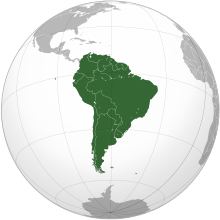
South America is a continent situated in the western hemisphere and, mostly, the southern hemisphere, bordered on the west by the Pacific Ocean and on the north and east by the Atlantic Ocean; North America and the Caribbean Sea lie to the northwest. As part of the Americas like North America, South America is named after Amerigo Vespucci, who was the first European to suggest that the Americas were not the East Indies, but a New World unknown to Europeans. South America has an area of 17,840,000 km² (6,890,000 sq mi), or almost 3.5% of the Earth's surface. As of 2005, its population was estimated at more than 371,000,000. South America ranks fourth in area (after Asia, Africa, and North America) and fifth in population (after Asia, Africa, Europe, and North America). |
| Español |
América del Sur, también llamado Sudamérica o Suramérica, es un subcontinente atravesado por la línea ecuatorial, con la mayor parte de su área en el Hemisferio Sur. Está situado entre el Océano Pacífico y el Océano Atlántico. Alternativamente, en algunos países de habla no hispana se considera un continente. |
| Português |
A América do Sul é um subcontinente que compreende a porção meridional das Américas. Sua extensão é de 17.819.100 km², abrangendo 12% da superfície terrestre, porém só tem 6% da população mundial. Une-se a América Central, ao norte, pelo istmo/canal do Panamá. Tem uma extensão de 7.400 km desde o mar do Caribe até o cabo de Hornos. |
| Population |
371,000,000 inhabitants |
| Area |
17,840,000 km² |
| Major language(s) |
Spanish, Portuguese |
| Major religion(s) |
Roman Catholicism |
| More information |
South America, Geography of South America, History of South America and Politics of South America |
| More images |
South America - South America (Category). |
|
General maps
 |
Location of the Americas |
 |
Map of the Americas |
 |
Countries of South America |
 |
Political map with 1st level divisions as of 1998 in SVG format |
History maps
This section holds a short summary of the history of the area of present-day South America, illustrated with maps, including historical maps of former countries and empires that included present-day South America.
 |
Colonization of the Americas |
| [[|border|251x400px]] |
Spanish and Portuguese colonization of the Americas |
 |
Countries in the Americas by date of independence |
Old maps
This section holds copies of original general maps older than 70 years of this entry.
 |
First map to show the name America |
 |
South America 1575 |
 |
Map of the Americas 1587 (Ortelius) |
 |
Map of the Americas 1637 (Hondius) |
 |
Map of the Americas 1705 |
 |
Map of the Americas 1722 |
 |
South America 1750 |
 |
Map of the Americas 1770 |
 |
South America 1790 |
 |
South America 1794 |
 |
South America 1885 |
 |
South America 1892 |
 |
South America 1905 |
 |
South America 1914 |
Maps of international organizations
 |
Mercosur states in South America |
Ethnic maps
 |
Indian population of the Americas |
Satellite maps
 |
Satellite map |
 |
Countries |
Notes and references
General remarks:
- The WIKIMEDIA COMMONS Atlas of the World is an organized and commented collection of geographical, political and historical maps available at Wikimedia Commons. The main page is therefore the portal to maps and cartography on Wikimedia. That page contains links to entries by country, continent and by topic as well as general notes and references.
- Every entry has an introduction section in English. If other languages are native and/or official in an entity, introductions in other languages are added in separate sections. The text of the introduction(s) is based on the content of the Wikipedia encyclopedia. For sources of the introduction see therefore the Wikipedia entries linked to. The same goes for the texts in the history sections.
- Historical maps are included in the continent, country and dependency entries.
- The status of various entities is disputed. See the content for the entities concerned.
- The maps of former countries that are more or less continued by a present-day country or had a territory included in only one or two countries are included in the atlas of the present-day country. For example the Ottoman Empire can be found in the Atlas of Turkey.
|
Entries available in the atlas