The introductions of the country, dependency and region entries are in the native languages and in English. The other introductions are in English.
|
|
|
བོད་
西藏 |
|
|
| བོད་ཡིག |
བོད་ - བོད་རང་སྐྱོང་ལྗོངས་[2]
བོད་རང་སྐྱོང་ལྗོངས་ བོད་ཨ་མདོ་ནི་མདོ་སྨད་སྒང་དྲུག་སྟེ། ད་ལྟའི་མཚོ་སྔོན་ཞིང་ཆེན་གྱི་ཁོངས་དང་། ཀན་སུའུ་ཞིང་ཆེན། སི་ཁྲོན་ཞིང་ཆེན་གྱི་ཁོངས་ཀྱི་བོད་པ་སྤྱི་ལ་གོ་དགོས།
|
| 中文 |
西藏 - 西藏自治区[3]
西藏(藏文བོད,拉丁文转写为Bod,在现代拉萨方言的发音为pö),古称吐蕃,現在一些流亡海外的藏人指吐蕃及西藏均含有貶義,建議改名為“圖博”)是位于东亚的一个区域,位于青藏高原之上。比邻尼泊尔、不丹及印度等地。现为中华人民共和国的一个自治区。
|
| English |
Tibet - Tibet Autonomous Region
Tibet is a plateau region in Central Asia and the indigeneous home to the Tibetan people. With an average elevation of 4,900 m (16,000 ft), it is the highest region on Earth and is commonly referred to as the "Roof of the World". Existing as a separate nation for centuries, Tibet is today administered mostly under the People's Republic of ► China. Tibet is also officially claimed by the Republic of China (Taiwan). However in the Tibetan sovereignty debate, the Chinese government and the Government of Tibet in Exile have disagreed over the legitimacy of Tibet becoming a part of China since 1959, and whether this incorporation into the Chinese homelands was legitimate. Tibet borders ► Xinjiang, ► Kashmir, ► India, ► Nepal and ► Bhutan. |
|
| Short name |
Tibet |
| Official name |
Tibet Autonomous Region |
| Status |
Autonomous region of ► China, disputed by Tibetan government in exile |
| Capital |
ལྷ་ས་ (Lhasa)
拉薩[4] |
| Population |
7,282,154 inhabitants (Greater Tibet), 2,616,329 inhabitants |
| Area |
2.5 million resp. 1 228 400 km² |
| Major languages |
Tibetan, Chinese |
| Major religions |
Buddhism and Chinese folk religion |
| More information |
Tibet, Geography of Tibet, History of Tibet and Politics of Tibet |
| More images |
Tibet - Tibet (Category). |
|
General maps
 |
Map of Tibet in the Chinese administrative divisions |
 |
Map of Tibet Autonomous Region |
 |
| |
|
|
|
|
|
Historic Tibet as claimed by Tibetan exile groups |
|
|
|
|
|
|
Tibetan areas designated by the PRC |
|
|
|
|
|
|
Tibet Autonomous Region (actual control) |
|
|
|
|
|
|
Claimed by India as part of Aksai Chin |
|
|
|
|
|
|
Claimed by PRC as part of TAR |
|
|
|
|
|
|
Other areas historically within Tibetan cultural sphere |
|
 |
Map of Tibet Autonomous Region |
-
Location of Tibet Autonomous Region
-
Lhasa (拉萨) City, capital of the Region
-
-
-
-
-
-
-
Overview of Tibet and surrounding Tibetan areas.
-
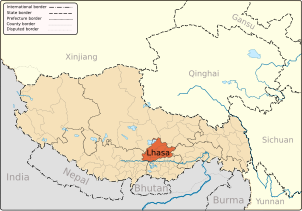
Map highlighting Lhasa Prefecture
-
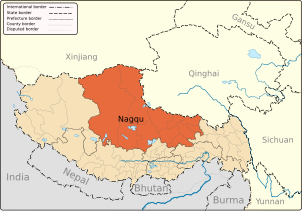
Map highlighting Nagqu Prefecture
-
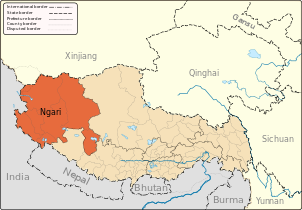
Map highlighting Ngari Prefecture
-
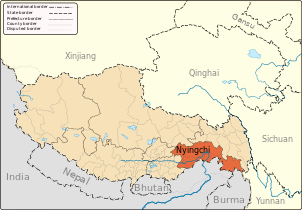
Map highlighting Nyinci Prefecture
-
Map highlighting Qamdo Prefecture
-
Map highlighting Shannan Prefecture
-
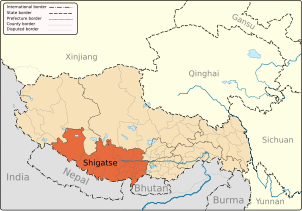
Map highlighting Shigatse Prefecture
-
a version for use as a locator map
 |
Ethnolinguistic Map of Tibet 1967 |
 |
Historic Tibet |
 |
Map of Tibet : Ü-Tsang Amdo and Kham |
 |
Satellite map of Tibet |
Old maps
This section holds copies of original general maps older than 70 years of this entry.
 |
« La Chine, la Tartarie Chinoise et le Thibet » in 1734 from Jean-Baptiste Bourguignon d'Anville |
 |
Map of Lhasa (1932) |
Notes and references
General remarks:
- The WIKIMEDIA COMMONS Atlas of the World is an organized and commented collection of geographical, political and historical maps available at Wikimedia Commons. The main page is therefore the portal to maps and cartography on Wikimedia. That page contains links to entries by country, continent and by topic as well as general notes and references.
- Every entry has an introduction section in English. If other languages are native and/or official in an entity, introductions in other languages are added in separate sections. The text of the introduction(s) is based on the content of the Wikipedia encyclopedia. For sources of the introduction see therefore the Wikipedia entries linked to. The same goes for the texts in the history sections.
- Historical maps are included in the continent, country and dependency entries.
- The status of various entities is disputed. See the content for the entities concerned.
- The maps of former countries that are more or less continued by a present-day country or had a territory included in only one or two countries are included in the atlas of the present-day country. For example the Ottoman Empire can be found in the Atlas of Turkey.
- ↑ Goldstein, Sherap, Siebenschuh "A Tibetan revolutionary: the political life and times of Bapa Phüntso Wangye", p175. After the 1959 Tibetan uprising the Chinese government outlawed the flag as a symbol of separatism. It continues to be used by the Government of Tibet in Exile
- ↑ Romanization of Tibetan: Bod - Bod-rang-skyong-ljongs.
- ↑ Romanization according to the Hanyu Pinyin standard: Xīzàng - Xīzàng Zìzhìqū.
- ↑ Romanization according to the Hanyu Pinyin standard: Lāsà.
|
Entries available in the atlas